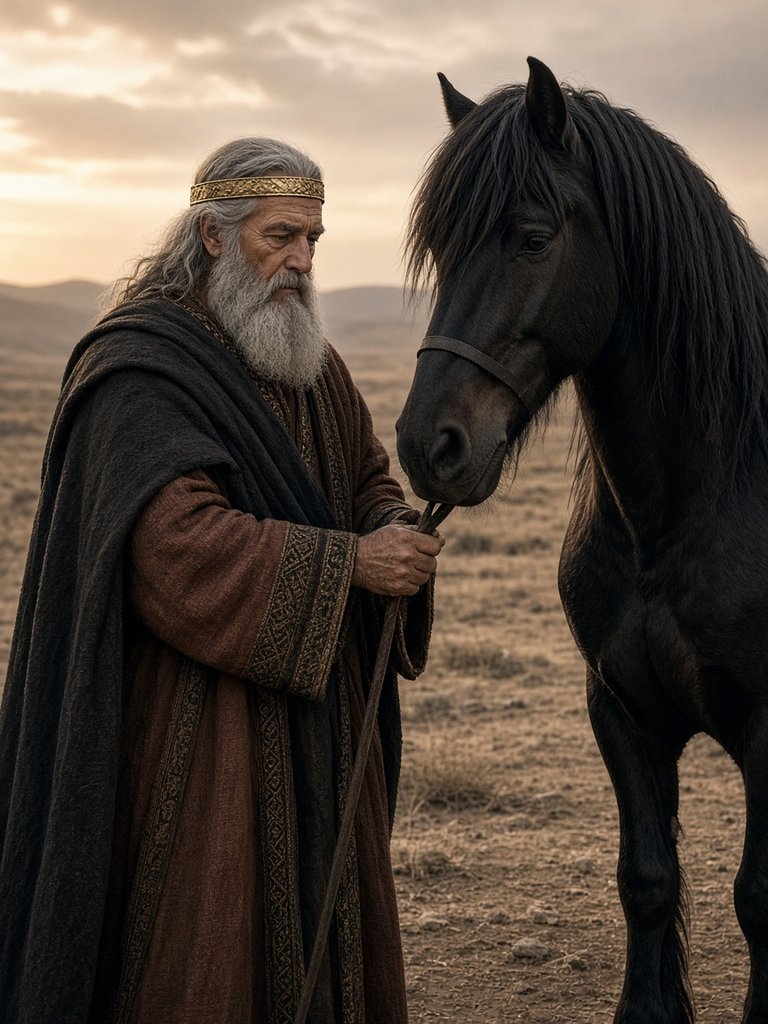
Adrastos, son of Talaos, was king of Argos and for a time of Sikyon, which the Iliad calls the place “where Adrastus reigned of old” (Iliad 2.572, tr. Butler). He gave his daughters in marriage to two exiles, Tydeus and Polyneikes, and promised to restore them to their lands (Apollodorus 3.6.1, paraphrased). Tydeus “married into the family of Adrastus” (Iliad 14.121, tr. Butler), and his daughter Aigialeia became the wife of Diomedes (Iliad 5.412).
He led the Seven against Thebes. All the other leaders died, and Adrastos alone escaped on his swift horse Arion, born of Poseidon (Apollodorus 3.6.8, paraphrased). Nestor speaks of “Adrestus’s horse Arion behind you—a horse which is of divine race” (Iliad 23.346–347, tr. Butler).
Ten years later he went with the Epigonoi, the sons of the Seven, who took Thebes; his own son Aigialeus was killed, and Adrastos died of grief on the way home, at Megara (Pausanias 1.43.1, paraphrased). At Sikyon he was honoured with tragic choruses until the tyrant Kleisthenes gave them to Dionysos (Herodotus 5.67).
Epithets
- Ἄδρηστος · Adrēstos
- the Homeric form of his name
- Ταλαϊονίδης · Talaïonidēs
- son of Talaos
Symbols and virtues
The leader who survives his companions. Symbols: the dark horse Arion.
Myths
- The two exiles. Apollodorus 3.6.1.
- The Seven against Thebes. Apollodorus 3.6.3–8.
- The horse Arion. Iliad 23.346–347.
- The Epigonoi. Apollodorus 3.7.2–3; Pausanias 1.43.1.
Cult and places
- Sikyon. Hero-shrine and tragic choruses (Herodotus 5.67).
- Megara. Hero-shrine where he died (Pausanias 1.43.1).
In the poets
“Adrestus’s horse Arion behind you—a horse which is of divine race.”Homer, Iliad 23.346–347, tr. Samuel Butler (1898), public domain.
Sources
Homer, Iliad 2.572, 5.412, 14.119–125, 23.346–347; Euripides, Suppliant Women; Herodotus 5.67; Apollodorus 3.6.1–3.7.3; Pausanias 1.43.1, 8.25.8.
Quotations in public-domain translations (Evelyn-White 1914, Butler 1898/1900, Taylor 1792); other authors paraphrased.