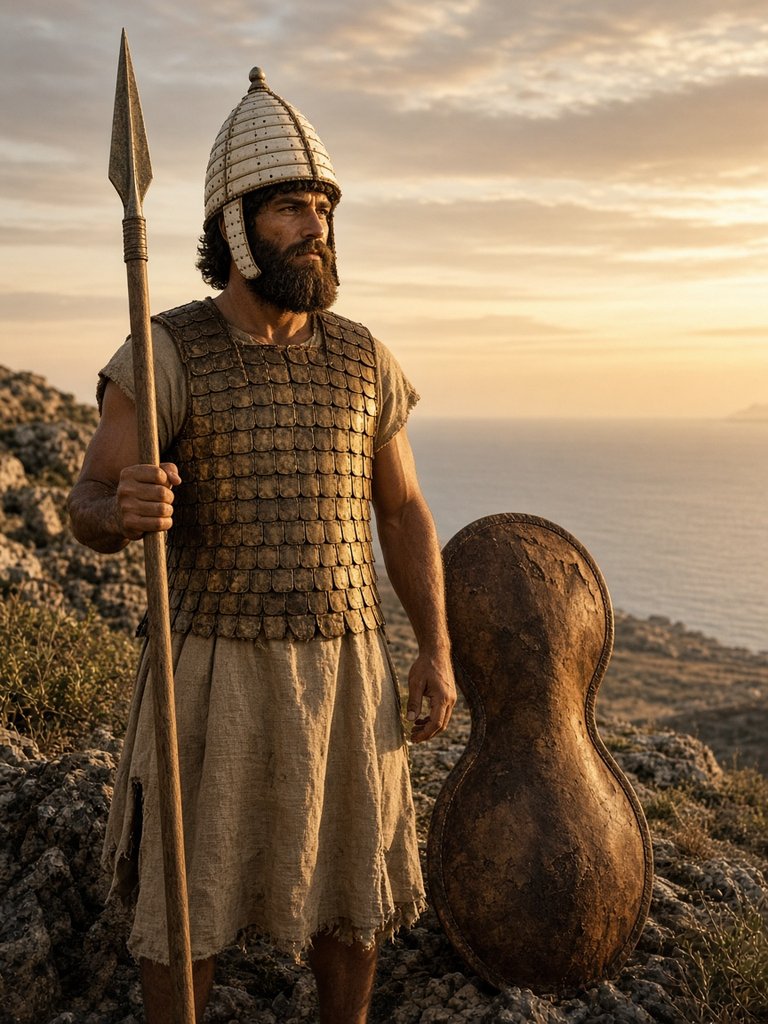
Tlepolemos was a son of Herakles. The Catalogue of Ships says: “Tlepolemus, son of Hercules, a man both brave and large of stature, brought nine ships of lordly warriors from Rhodes” (Iliad 2.653–654, tr. Butler). His mother was Astyocheia, whom Herakles had carried off from Ephyra.
When he grew up he killed his father’s uncle Likymnios, who was then an old man. Threatened by the other sons and grandsons of Herakles, he built a fleet and fled overseas, and after a hard voyage settled on Rhodes, where his people lived in three communities, Lindos, Ialysos and Kameiros (Iliad 2.661–670, paraphrased).
At Troy he met Sarpedon, son of Zeus, taunted him, and recalled how Herakles had sacked Troy over Laomedon’s horses. They threw at the same moment: Sarpedon’s spear went through his throat and killed him, while his own spear tore into Sarpedon’s thigh (Iliad 5.628–662, paraphrased). Pindar honours him as the founder of Rhodes (Olympian 7.20–33, 77–80, paraphrased).
Epithets
- ἠΰς τε μέγας τε · ēüs te megas te
- brave and tall (Iliad 2.653)
Symbols and virtues
The exile who founds a new home. Symbols: the nine ships, the spear.
Myths
- Leader of the Rhodians. Iliad 2.653–656.
- Killing of Likymnios and flight to Rhodes. Iliad 2.661–670.
- Duel with Sarpedon. Iliad 5.628–662.
- Founder of Rhodes. Pindar, Olympian 7.20–33.
Cult and places
- Rhodes. Honoured as founder (Pindar, Olympian 7.77–80).
In the poets
“Tlepolemus, son of Hercules, a man both brave and large of stature, brought nine ships of lordly warriors from Rhodes.”Homer, Iliad 2.653–654, tr. Samuel Butler (1898), public domain.
Sources
Homer, Iliad 2.653–670, 5.628–662; Pindar, Olympian 7; Apollodorus 2.8.2.
Quotations in public-domain translations (Evelyn-White 1914, Butler 1898/1900, Taylor 1792); other authors paraphrased.