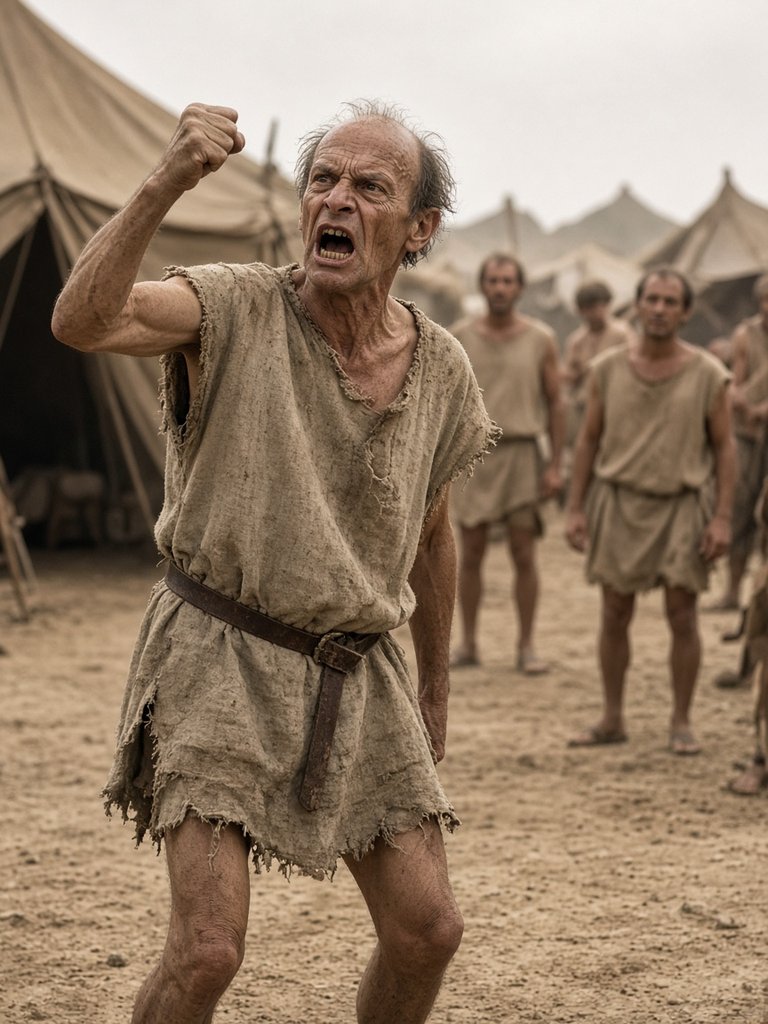
Thersites is the only common soldier who speaks in the Iliad’s assembly, and Homer paints him without mercy: “a man of many words, and those unseemly; a monger of sedition, a railer against all who were in authority, who cared not what he said, so that he might set the Achaeans in a laugh. He was the ugliest man of all those that came before Troy—bandy-legged, lame of one foot, with his two shoulders rounded and hunched over his chest” (Iliad 2.212–218, tr. Butler).
He abuses Agamemnon for his greed, and his words repeat much of what Achilles had said. Odysseus rebukes him and beats him with the royal sceptre until a bloody weal rises on his back, and the army laughs and praises Odysseus (Iliad 2.244–277, paraphrased).
In the lost epic Aithiopis he mocked Achilles for his supposed love for the dead Amazon queen Penthesileia, and Achilles killed him (Proclus, summary of the Aithiopis, paraphrased).
Epithets
- ἀμετροεπής · ametroepēs
- of unmeasured speech (Iliad 2.212)
- αἴσχιστος ἀνήρ · aischistos anēr
- the ugliest man (Iliad 2.216)
Symbols and virtues
Free speech without measure; the voice of the ranks against the kings. Symbols: the sceptre that strikes him.
Myths
- In the assembly. Iliad 2.211–277.
- Death by Achilles. Proclus, Aithiopis.
In the poets
“He was the ugliest man of all those that came before Troy—bandy-legged, lame of one foot, with his two shoulders rounded and hunched over his chest.”Homer, Iliad 2.216–218, tr. Samuel Butler (1898), public domain.
Sources
Homer, Iliad 2.211–277; Proclus, Chrestomathy (Aithiopis).
Quotations in public-domain translations (Evelyn-White 1914, Butler 1898/1900, Taylor 1792); other authors paraphrased.