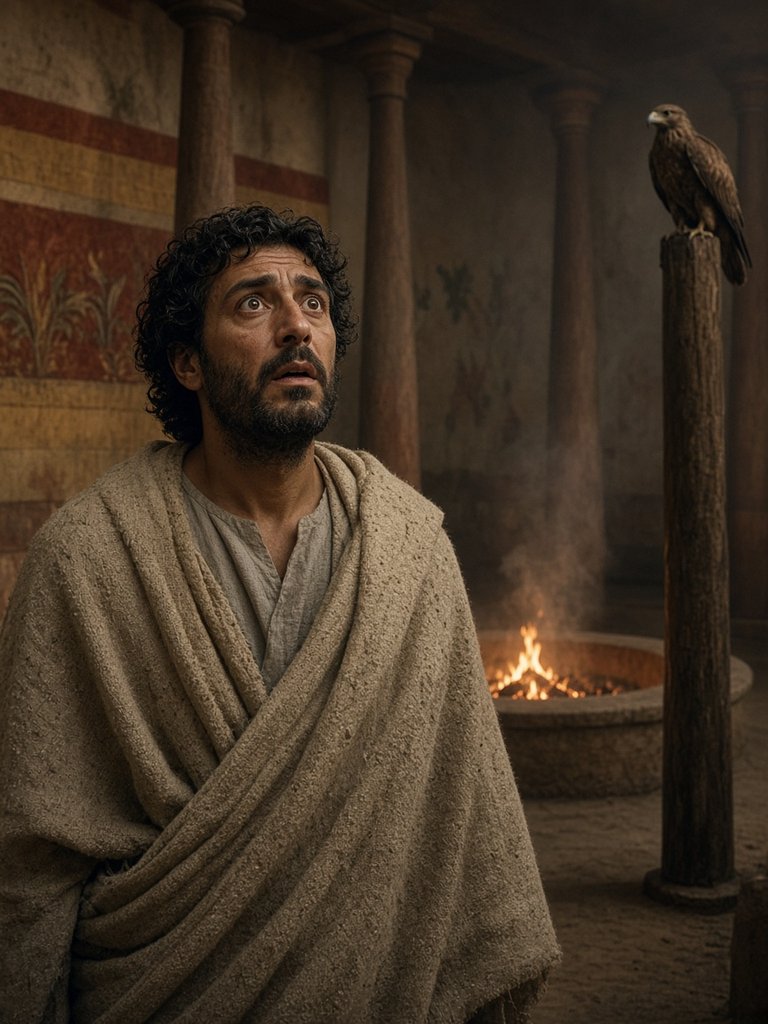
Theoklymenos was a seer descended from Melampous; his father was Polypheides, whom Apollo made the greatest seer in the world after the death of Amphiaraos (Odyssey 15.223–256, paraphrased). Exiled from Argos for killing a kinsman, he begged Telemachos at Pylos to take him on board, and was brought to Ithaca (Odyssey 15.256–286, paraphrased).
On landing he read a hawk carrying a dove as a sign that the house of Odysseus would remain the royal line (Odyssey 15.525–534, paraphrased), and he swore to Penelope that Odysseus was already in Ithaca (Odyssey 17.151–161, paraphrased).
At the last feast of the suitors he saw their doom: “There is a shroud of darkness drawn over you from head to foot, your cheeks are wet with tears; the air is alive with wailing voices; the walls and roof-beams drip blood” (Odyssey 20.351–354, tr. Butler). They laughed, and he left the house (Odyssey 20.358–372, paraphrased).
Epithets
- μάντις · mantis
- seer
Symbols and virtues
Second sight and the guest who must be honoured. Symbols: the hawk and dove, the shroud of darkness.
Myths
- Lineage of Melampous. Odyssey 15.223–256.
- Taken aboard by Telemachos. Odyssey 15.256–286.
- Omen of the hawk. Odyssey 15.525–534.
- Vision of the suitors’ doom. Odyssey 20.350–357.
In the poets
“There is a shroud of darkness drawn over you from head to foot, your cheeks are wet with tears; the air is alive with wailing voices; the walls and roof-beams drip blood.”Homer, Odyssey 20.351–354, tr. Samuel Butler (1900), public domain.
Sources
Homer, Odyssey 15.223–286, 15.525–534, 17.151–161, 20.345–372.
Quotations in public-domain translations (Evelyn-White 1914, Butler 1898/1900, Taylor 1792); other authors paraphrased.