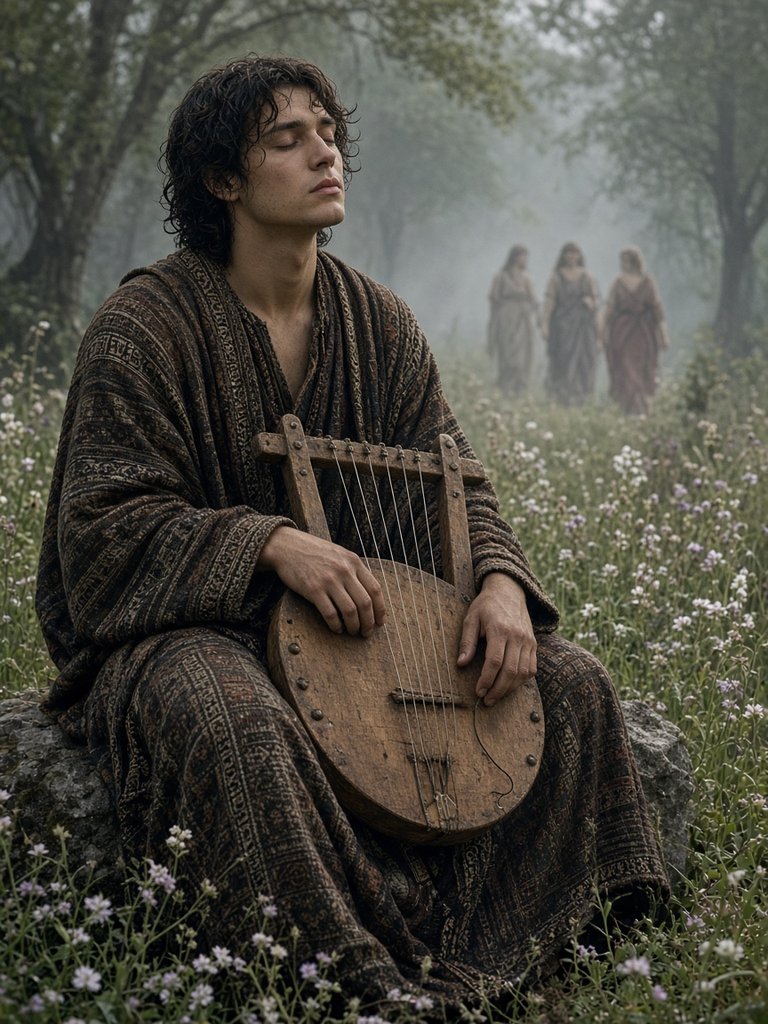
Thamyris was a Thracian singer, son of Philammon and the nymph Argiope (Apollodorus 1.3.3, paraphrased). The Iliad names Dorion in Nestor’s kingdom as the place “where the Muses met Thamyris, and stilled his minstrelsy for ever. He was returning from Oechalia, where Eurytus lived and reigned, and boasted that he would surpass even the Muses, daughters of aegis-bearing Jove, if they should sing against him; whereon they were angry, and maimed him” (Iliad 2.594–599, tr. Butler).
Apollodorus adds the terms of the contest: if Thamyris won, he would lie with each of the Muses; if he lost, they might take from him what they wished. They won, and took his eyes and his art of song (Apollodorus 1.3.3, paraphrased).
Pausanias reports that he threw his lyre into a Messenian stream, which was then called Balyra, and that Polygnotos painted him at Delphi among the dead, blind, his broken lyre at his feet (Pausanias 4.33.3, 10.30.8, paraphrased). In Plato’s myth of Er the soul of Thamyras chooses the life of a nightingale (Republic 620a, paraphrased).
Epithets
- Θρῇξ · Thrēïx
- the Thracian
Symbols and virtues
Pride in art punished by the givers of art. Symbols: the lyre, the broken string, the blind eyes.
Myths
- Maimed by the Muses at Dorion. Iliad 2.594–600.
- The terms of the contest. Apollodorus 1.3.3.
- The lyre thrown into the Balyra. Pausanias 4.33.3.
- Blind among the dead. Pausanias 10.30.8.
In the poets
“Where the Muses met Thamyris, and stilled his minstrelsy for ever.”Homer, Iliad 2.594–595, tr. Samuel Butler (1898), public domain.
Sources
Homer, Iliad 2.594–600; Plato, Republic 620a; Apollodorus 1.3.3; Pausanias 4.33.3, 9.30.2, 10.30.8.
Quotations in public-domain translations (Evelyn-White 1914, Butler 1898/1900, Taylor 1792); other authors paraphrased.