Tantalos, a son of Zeus and king at Mount Sipylos in Lydia, was the father of Pelops and Niobe. He was so honoured that he dined with the gods, but abused their favour. Pindar says he stole their nectar and ambrosia to give to his friends (Olympian 1.54–64, paraphrased); others told that he served them his own son at a feast (Apollodorus, Epitome 2.1–3, paraphrased).
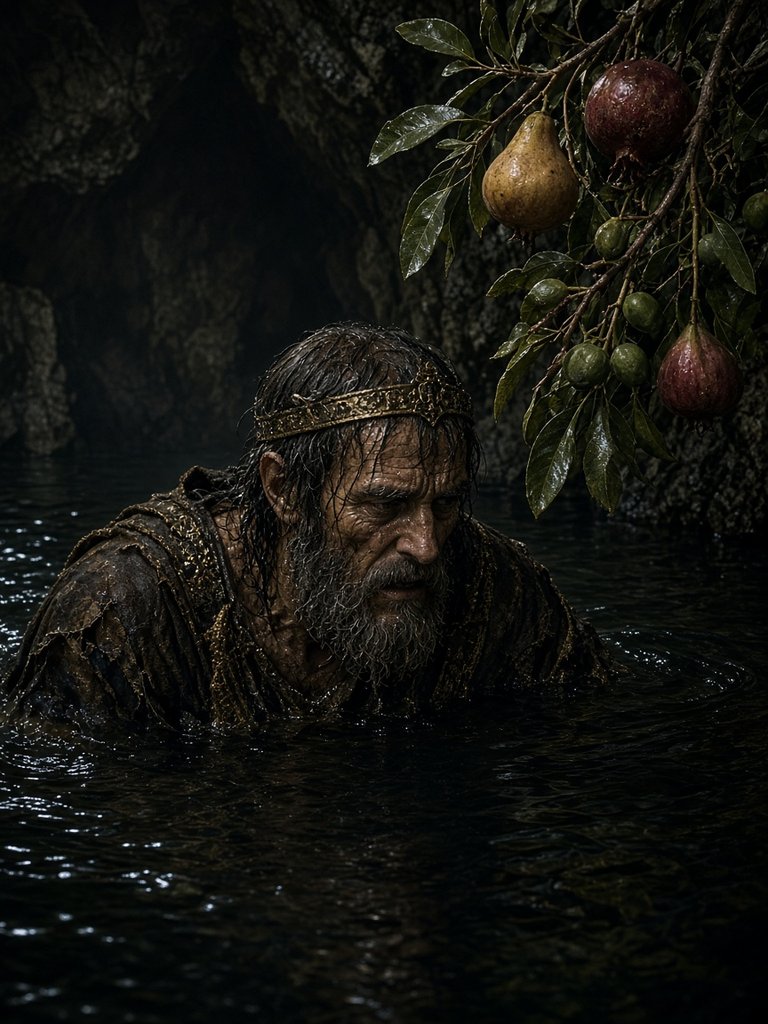
In the underworld Odysseus sees his punishment: “I saw also the dreadful fate of Tantalus, who stood in a lake that reached his chin; he was dying to quench his thirst, but could never reach the water, for whenever the poor creature stooped to drink, it dried up and vanished” (Odyssey 11.582–586, tr. Butler).
Above him hang “pears, pomegranates, apples, sweet figs and juicy olives, but whenever the poor creature stretched out his hand to take some, the wind tossed the branches back again to the clouds” (Odyssey 11.588–592, tr. Butler). Pindar instead speaks of a great stone hanging over his head (Olympian 1.57–58, paraphrased). From his name comes the English word tantalise.
Epithets
- Διὸς υἱός · Dios huios
- son of Zeus
- Σιπύλου βασιλεύς · Sipulou basileus
- king of Sipylos
Symbols and virtues
Excess and abuse of the gods’ friendship; desire never satisfied. Symbols: the receding water, the fruit just out of reach.
Myths
- Guest of the gods. Pindar, Olympian 1.54–64.
- The feast of Pelops. Apollodorus, Epitome 2.1–3.
- Punishment. Odyssey 11.582–592.
Cult and places
- Sipylos. His tomb was shown on Mount Sipylos (Pausanias 2.22.3).
In the poets
“I saw also the dreadful fate of Tantalus, who stood in a lake that reached his chin; he was dying to quench his thirst, but could never reach the water.”Homer, Odyssey 11.582–584, tr. Samuel Butler (1900), public domain.
Sources
Homer, Odyssey 11.582–592; Pindar, Olympian 1.35–66; Apollodorus, Epitome 2.1–3; Pausanias 2.22.3.
Quotations in public-domain translations (Evelyn-White 1914, Butler 1898/1900, Taylor 1792); other authors paraphrased.