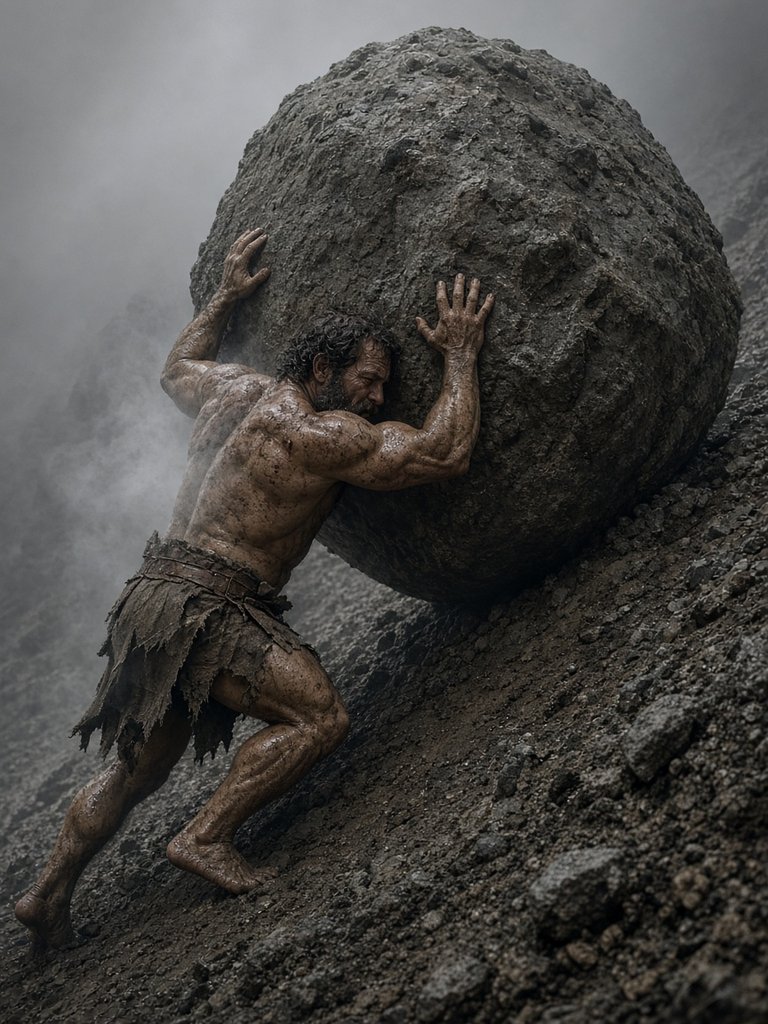
Sisyphos, son of Aiolos, ruled Ephyra, later called Corinth. Glaukos names him in his lineage: “a city in the heart of Argos, pasture land of horses, called Ephyra, where Sisyphus lived, who was the craftiest of all mankind” (Iliad 6.152–153, tr. Butler); he was the great-great-grandfather of Glaukos through Bellerophon.
Later writers tell of his tricks: he told the river-god Asopos that Zeus had carried off his daughter Aigina; he chained Thanatos so that no one died; and he told his wife not to bury him, so that he could persuade Hades to let him go back to punish her neglect (Apollodorus 1.9.3; Pherecydes, paraphrased).
In the underworld Odysseus sees his punishment: “I saw Sisyphus at his endless task raising his prodigious stone with both his hands. With hands and feet he tried to roll it up to the top of the hill, but always, just before he could roll it over on to the other side, its weight would be too much for him” (Odyssey 11.593–597, tr. Butler). He was also said to have founded the Isthmian Games for Melikertes (Pausanias 2.1.3, paraphrased).
Epithets
- Αἰολίδης · Aiolidēs
- son of Aiolos
- κέρδιστος ἀνδρῶν · kerdistos andrōn
- craftiest of men (Iliad 6.153)
Symbols and virtues
Cunning that outwits even death, and endless labour. Symbols: the great stone, the hill.
Myths
- King of Ephyra. Iliad 6.152–155.
- Death in chains. Pherecydes; Apollodorus 1.9.3.
- The stone. Odyssey 11.593–600.
- The Isthmian Games. Pausanias 2.1.3.
Cult and places
- Corinth. Founder of the Isthmian Games (Pausanias 2.1.3).
In the poets
“I saw Sisyphus at his endless task raising his prodigious stone with both his hands.”Homer, Odyssey 11.593–594, tr. Samuel Butler (1900), public domain.
Sources
Homer, Iliad 6.152–155; Odyssey 11.593–600; Apollodorus 1.9.3; Pausanias 2.1.3, 2.2.2.
Quotations in public-domain translations (Evelyn-White 1914, Butler 1898/1900, Taylor 1792); other authors paraphrased.