Gary Todd, CC0, via Wikimedia Commons

The Sirens are singers who enchant every man who comes near them; whoever hears their voice never comes home to wife and children. They sit in a meadow, and around them lies a great heap of the bones of rotting men (Odyssey 12.39–46). Kirki told Odysseus to stop his crew’s ears with wax and to have himself bound to the mast if he wished to hear (Odyssey 12.47–54). Homer’s Greek speaks of two Sirens, in the dual number (Odyssey 12.52, 12.167).
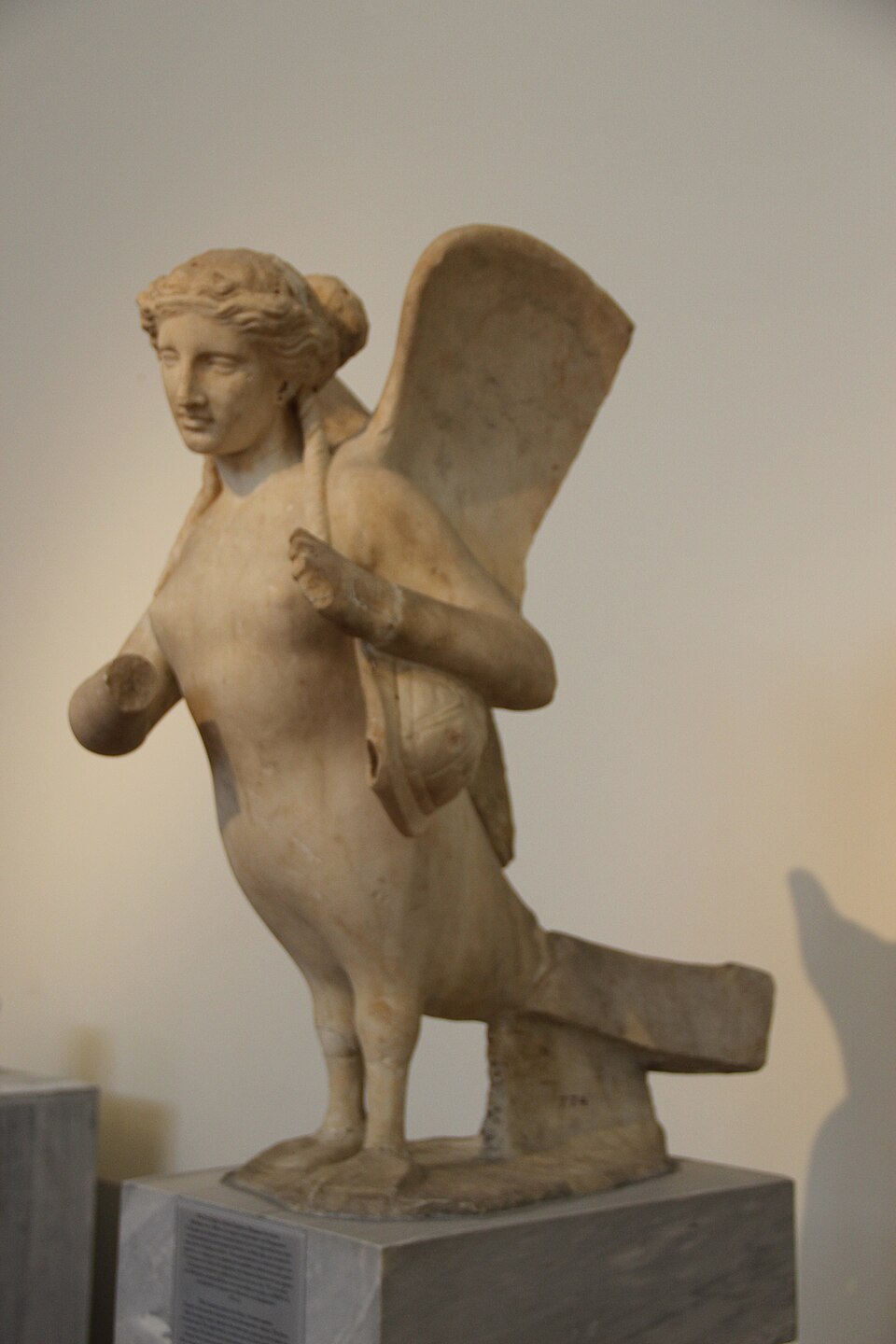
Their song promises knowledge: they know all that the Argives and Trojans suffered at Troy, and all that happens on the fruitful earth (Odyssey 12.184–191). Later poets made them daughters of the river Acheloos and a Muse; Apollonios tells how Orpheus drowned their song with his lyre as the Argo passed (Argonautika 4.891–919). Pausanias heard that they challenged the Muses to a contest of song and lost, and the Muses made crowns of their feathers (Pausanias 9.34.3). Plato set a Siren on each whorl of the spindle of Necessity, each singing one note, so that the eight make one harmony (Republic 10.617b). In Attic cemeteries their marble images mourned over graves.
Epithets
- Θεσπέσιαι · Thespesiai
- divinely singing (Odyssey 12.158)
- Λιγυρὴ ἀοιδή · Ligyre aoide
- their clear-voiced song (Odyssey 12.44)
Domains and symbols
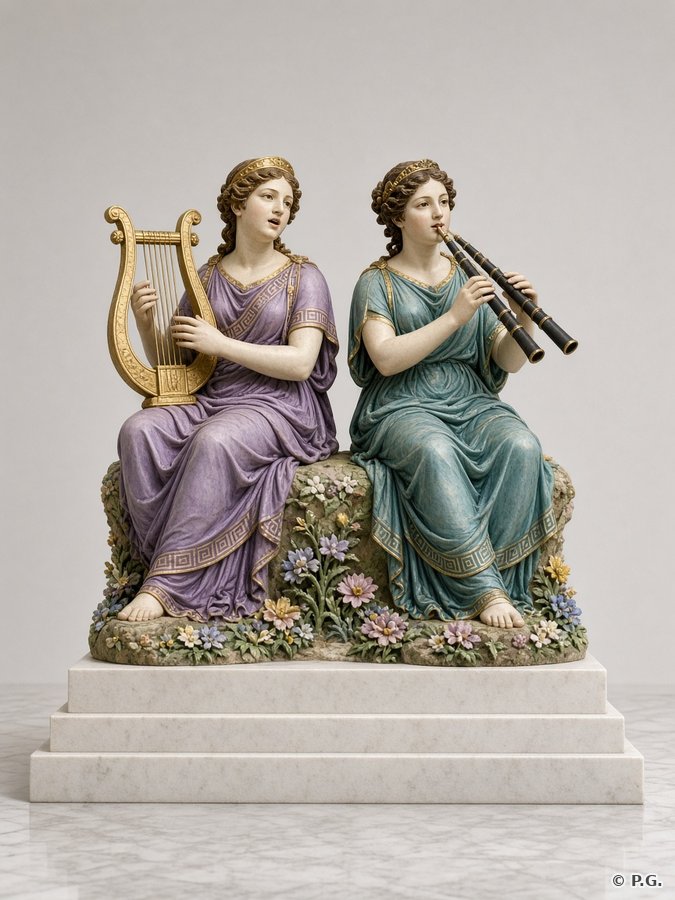
The lure of knowledge and pleasure that ends the journey home; in later thought, the music of the spheres and the mourning of the dead. Admire: self-knowledge, binding oneself in advance. Sacred symbols: the flowery meadow, the song, the lyre and pipes of later art.
Myths
- Kirki’s warning. Wax for the crew, the mast for Odysseus (Odyssey 12.39–54).
- The calm and the song. Odyssey 12.158–191.
- Bound tighter. Perimedes and Eurylochos tie him fast (Odyssey 12.192–200).
- Orpheus outsings them. Apollonios, Argonautika 4.891–919.
- The contest with the Muses. Pausanias 9.34.3.
- The spindle of Necessity. Plato, Republic 10.617b.
Offerings
The Sirens received no cult; as mourners they stood over Attic graves. Today: music in memory of the dead.
Beneath the Divine Mind
The Sirens are the Divine Mind as a test: knowledge offered without the journey, sweetness that keeps the soul from home. Plato turns them into the harmony of the heavens, the true song heard only by the soul that has returned. Like every god they stand stands beneath the One (The One and the Many).
Honouring the Sirens today
- Self-binding. Make a promise in advance that will hold you when you are tempted.
- Music. Play or sing in memory of someone who has died.
- Reading. Read Odyssey 12.153–200.
Sources
Homer, Odyssey 12.39–54, 12.153–200; Apollonios, Argonautika 4.891–919; Pausanias 9.34.3; Plato, Republic 10.617b.
Quotations in public-domain translations (Evelyn-White 1914, Butler 1898/1900, Taylor 1792); other authors paraphrased.