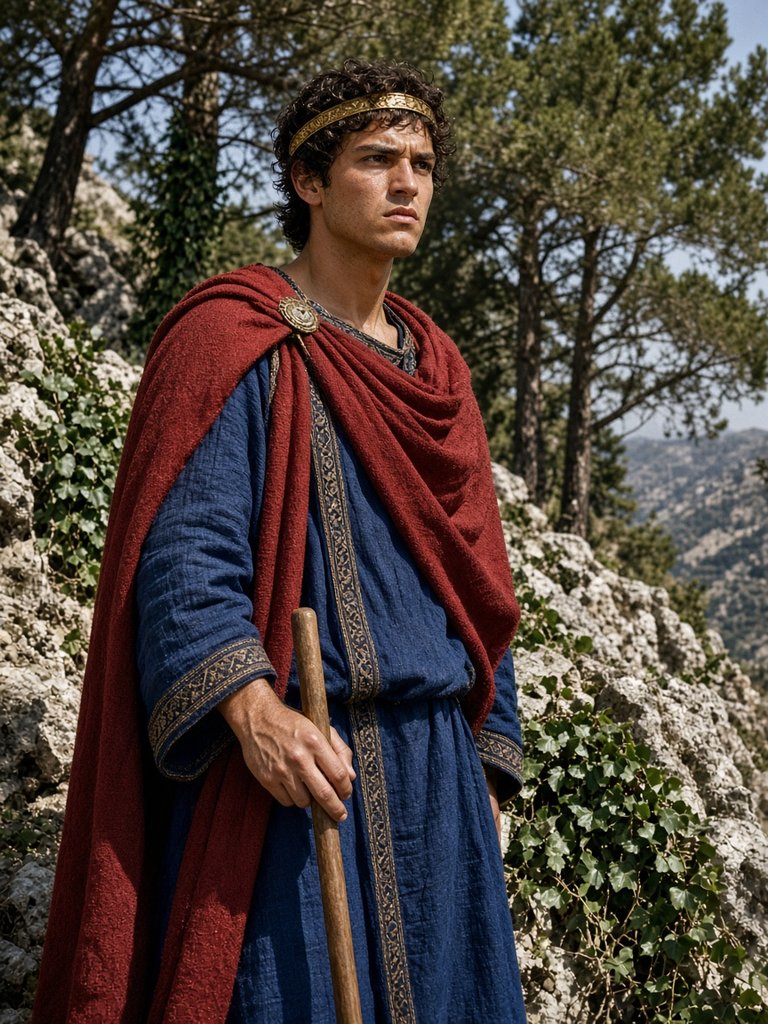
Pentheus, son of Echion and Agave, grandson of Kadmos, became king of Thebes. When his cousin Dionysos returned to Thebes and drove its women to the mountain as maenads, Pentheus refused to accept him as a god, imprisoned him, and threatened his followers (Euripides, Bacchae 215–262, 434–518, paraphrased). Teiresias and old Kadmos warned him in vain.
Dionysos escaped his chains, shook the palace and then led the young king, bewildered and dressed as a woman, to spy on the maenads on Mount Kithairon (Bacchae 576–976, paraphrased). Teiresias plays on his name, which recalls penthos, grief (Bacchae 367).
The women saw him in a pine tree, pulled it down and tore him apart, his own mother Agave leading them. She carried his head back to Thebes believing it was a lion’s, until Kadmos brought her to her senses (Bacchae 1043–1329, paraphrased). Pausanias saw two images of Dionysos at Corinth said to be made from the wood of that tree (2.2.7).
Epithets
- Πενθεύς · Pentheus
- his name recalls penthos, grief (Bacchae 367)
Symbols and virtues
Resistance to the god and its terrible end. Symbols: the pine tree, the thyrsos of the maenads.
Myths
- Opposing Dionysos. Euripides, Bacchae 215–518.
- The spy on Kithairon. Bacchae 912–976.
- Torn by Agave. Bacchae 1043–1329.
Sources
Euripides, Bacchae; Theocritus 26; Apollodorus 3.5.2; Ovid, Metamorphoses 3.511–733; Pausanias 2.2.7.
Quotations in public-domain translations (Evelyn-White 1914, Butler 1898/1900, Taylor 1792); other authors paraphrased.