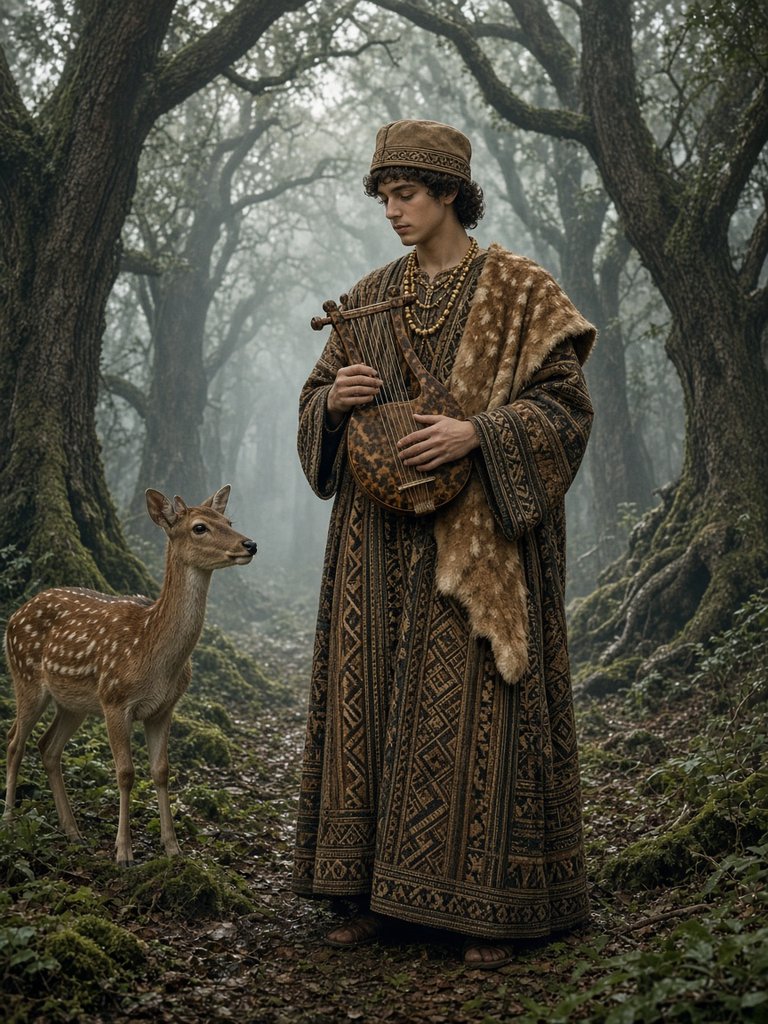
Orpheus is the singer of Thrace, son of the Muse Kalliope and of Oiagros, or of Apollo (Apollodorus 1.3.2, paraphrased). Pindar calls him the lyre-player and father of songs, sent by Apollo to sail with the Argonauts (Pythian 4.176–177, paraphrased), and Apollonius opens the Argonautica with him, whose singing charmed the rocks and rivers and led the oak trees down from the mountains in order (Argonautica 1.23–31, paraphrased). On the voyage his lyre outsang the Sirens (Argonautica 4.891–911, paraphrased).
When his wife Eurydike died of a snake-bite he went down to the house of Hades and Persephone, and his song moved them to let her follow him up, on condition that he did not look back; at the edge of the light he turned and lost her (Virgil, Georgics 4.453–527; Ovid, Metamorphoses 10.1–85, paraphrased). Plato knows the story in a harsher form, in which the gods showed him only a phantom of his wife (Symposium 179d, paraphrased). Grieving, he shunned women, and the Thracian women, Maenads of Dionysos, tore him apart; his head and lyre floated singing down the Hebros to Lesbos (Ovid, Metamorphoses 11.1–66, paraphrased).
The Greeks made Orpheus the founder of mysteries and the author of sacred poems and hymns; the collection of Orphic Hymns that this temple uses in Thomas Taylor’s translation (1792) goes under his name, though it was composed much later. Pausanias records his tomb at Dion and the story of its fall at Leibethra on Olympos, and a statue of him beside Telete, Initiation, on Mount Helikon (Pausanias 9.30.4–12, paraphrased).
Epithets
- πατὴρ ἀοιδᾶν · patēr aoidan
- father of songs (Pindar, Pythian 4.176)
- ὀνομάκλυτος · onomaklutos
- of famous name (Ibycus, fragment 306)
Symbols and virtues
Song that moves stones, beasts and the gods below; love that would undo death. Symbols: the lyre, the Thracian cap, the beasts and trees that follow his music.
Myths
- With the Argonauts. Pindar, Pythian 4.176–177; Apollonius 1.23–34.
- Against the Sirens. Apollonius, Argonautica 4.891–911.
- Eurydike. Virgil, Georgics 4.453–527; Ovid, Metamorphoses 10.1–85.
- His death. Ovid, Metamorphoses 11.1–66.
- The singing head. Ovid, Metamorphoses 11.50–55.
Cult and places
- Dion and Leibethra. His tomb (Pausanias 9.30.7–11).
- Helikon. Statue with Telete (Pausanias 9.30.4).
Sources
Pindar, Pythian 4.176–177; Plato, Symposium 179d; Apollonius of Rhodes, Argonautica 1.23–34, 4.891–911; Virgil, Georgics 4.453–527; Ovid, Metamorphoses 10.1–85, 11.1–66; Apollodorus, Library 1.3.2; Pausanias 9.30.4–12.
Quotations in public-domain translations (Evelyn-White 1914, Butler 1898/1900, Taylor 1792); other authors paraphrased.