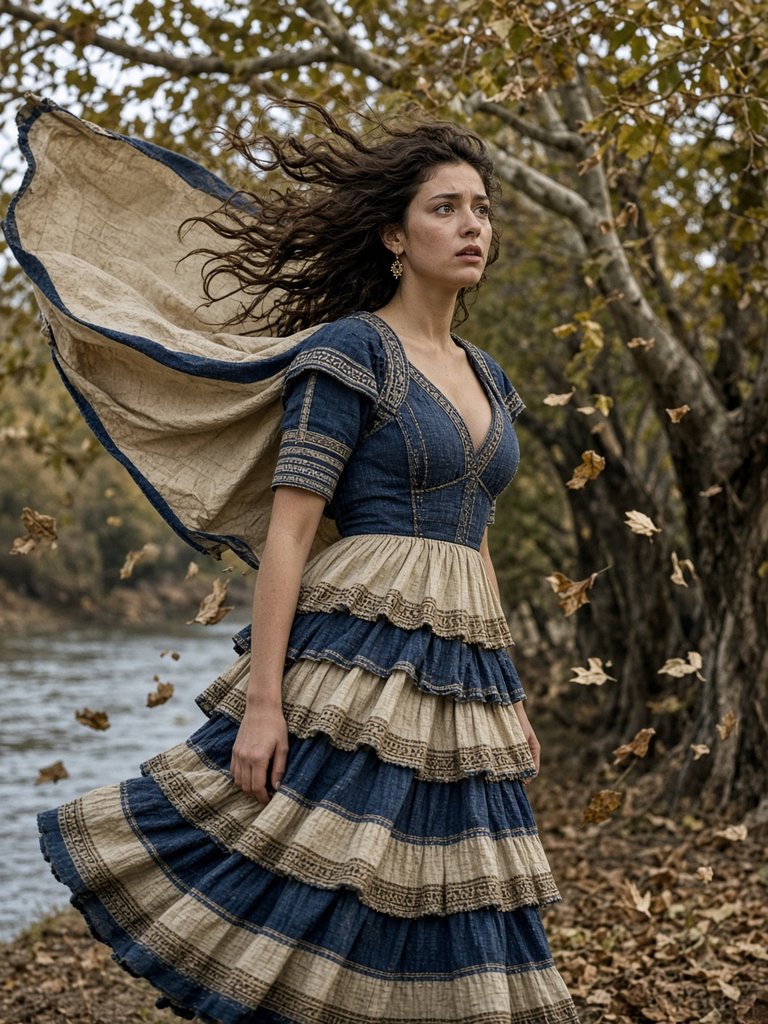
Oreithyia was a daughter of Erechtheus, king of Athens. While she was playing by the river Ilissos, Boreas, the North Wind, seized her and carried her off to Thrace (Apollodorus 3.15.2; Plato, Phaedrus 229b–d, paraphrased). She is not the Nereid of the same name.
In Plato’s Phaedrus Socrates and Phaidros walk along the Ilissos and pass the spot where the story was told; Socrates mentions the rationalizing version that a gust of wind blew her over the rocks, but declines to explain the myths away (Phaedrus 229b–230a, paraphrased).
She bore Boreas two winged sons, Zetes and Kalais, who sailed with the Argonauts and drove the Harpies from Phineus, and two daughters, Chione and Kleopatra (Apollodorus 3.15.2, paraphrased). Before the sea-battle at Artemision the Athenians prayed to Boreas as their son-in-law, and after the storm that wrecked the Persian fleet they built him a shrine by the Ilissos (Herodotus 7.189, paraphrased).
Epithets
- Ἐρεχθηΐς · Erechthēïs
- daughter of Erechtheus
Symbols and virtues
Seizure by the wind, and a bond between a city and a god. Symbols: the river Ilissos, the north wind.
Myths
- Carried off by Boreas. Apollodorus 3.15.2; Plato, Phaedrus 229b–d.
- Mother of Zetes and Kalais. Apollodorus 3.15.2.
- Boreas the son-in-law of Athens. Herodotus 7.189.
Cult and places
- Athens. A shrine of Boreas by the Ilissos, built after the storm off Artemision (Herodotus 7.189).
Sources
Herodotus 7.189; Plato, Phaedrus 229b–230a; Apollonius, Argonautica 1.211–223; Apollodorus 3.15.2; Pausanias 1.19.5; Ovid, Metamorphoses 6.682–713.
Quotations in public-domain translations (Evelyn-White 1914, Butler 1898/1900, Taylor 1792); other authors paraphrased.