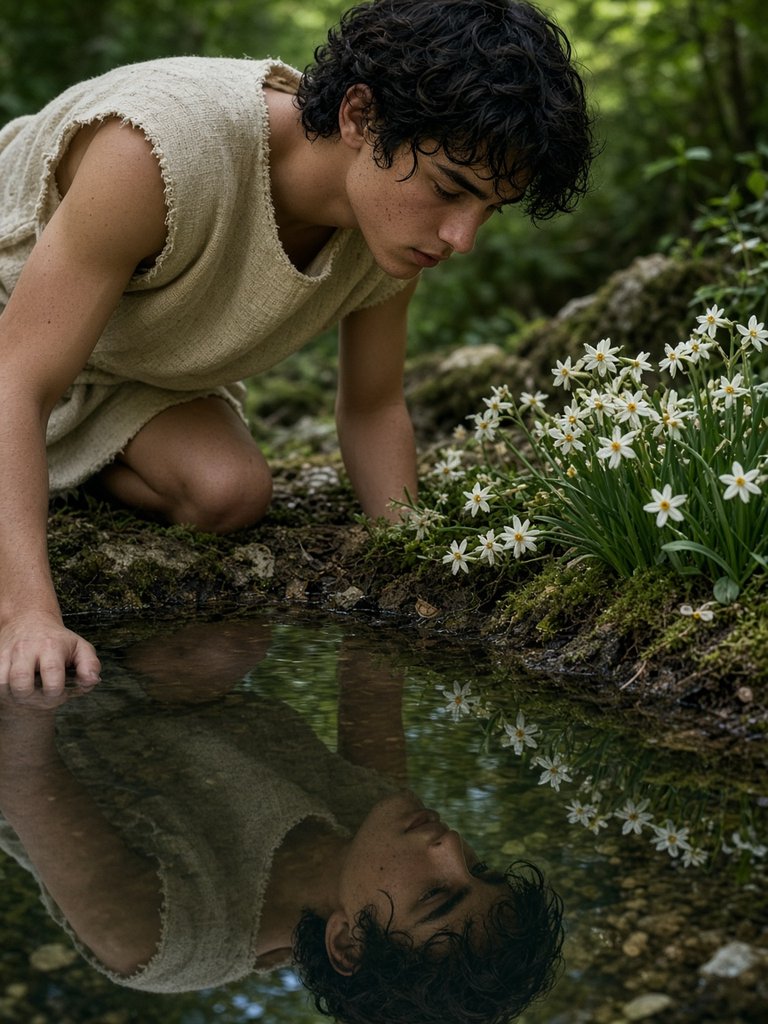
Narkissos was a youth of Thespiai in Boeotia, son of the river Kephisos and the nymph Liriope. When his mother asked the seer Teiresias whether he would live a long life, the answer was yes, if he never came to know himself (Ovid, Metamorphoses 3.339–350, paraphrased).
Many loved him, among them the nymph Echo, but he scorned them all. One of those he rejected prayed that he might love and never win his beloved, and Nemesis heard. Stooping to drink at a clear spring, Narkissos fell in love with his own reflection and wasted away beside it; where his body had been, the nymphs found only the flower that bears his name (Metamorphoses 3.351–510, paraphrased).
Pausanias tells the story at the spring of Donakon near Thespiai, but doubts it: in another version Narkissos loved his twin sister and, after her death, gazed into the spring to see her face in his own (9.31.7–8, paraphrased). Conon tells of a rejected lover, Ameinias, who killed himself at his door (Narrations 24).
Epithets
- νάρκισσος · narkissos
- the narcissus flower
Symbols and virtues
Self-love and the punishment of scorn. Symbols: the spring, the reflection, the narcissus flower.
Myths
- The prophecy of Teiresias. Ovid, Metamorphoses 3.339–350.
- Echo. Metamorphoses 3.356–401.
- The reflection and the flower. Metamorphoses 3.402–510.
- The twin sister. Pausanias 9.31.7–8.
Cult and places
- Thespiai. The spring of Donakon (Pausanias 9.31.7).
Sources
Ovid, Metamorphoses 3.339–510; Conon, Narrations 24; Pausanias 9.31.7–8.
Quotations in public-domain translations (Evelyn-White 1914, Butler 1898/1900, Taylor 1792); other authors paraphrased.