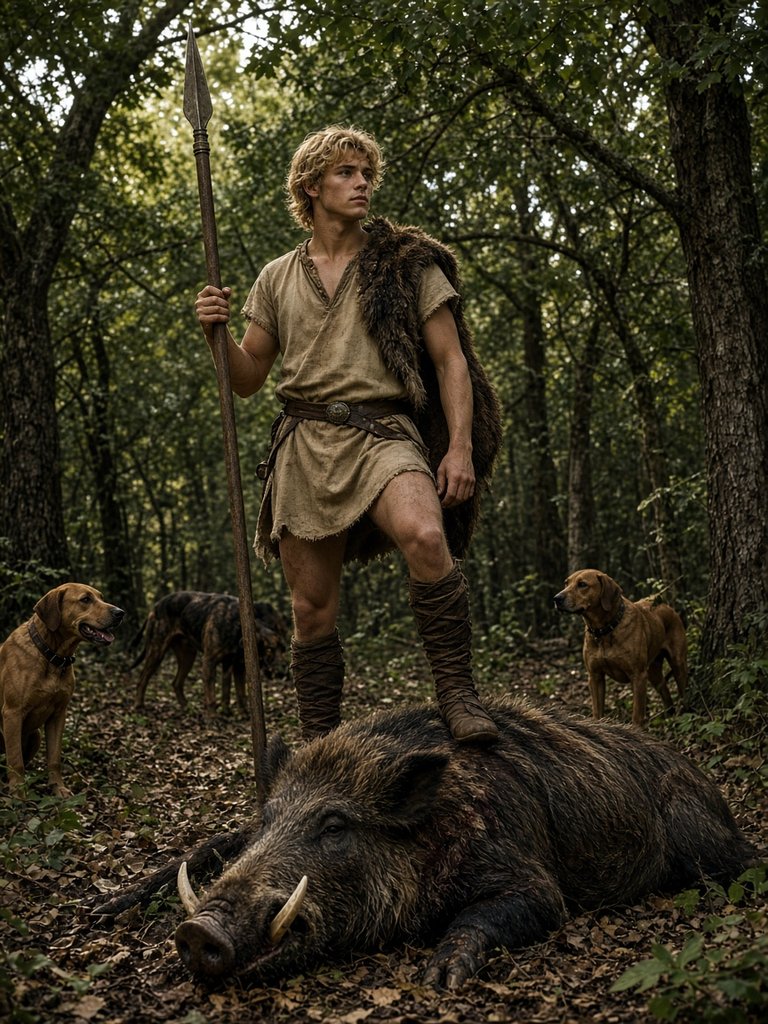
Meleagros, son of Oineus king of Kalydon and Althaia, is the hero of the Kalydonian boar hunt. In the Iliad Phoinix tells the story: Artemis, angry that Oineus left her out of his harvest offerings, sent a great boar, “But Meleager son of Oeneus got huntsmen and hounds from many cities and killed it—for it was so monstrous that not a few were needed, and many a man did it stretch upon his funeral pyre” (Iliad 9.543–546, tr. Butler).
In the war that followed over the boar’s head and hide he withdrew in anger at his mother’s curses, and returned to save the city only when the walls were burning, too late to receive the gifts that had been promised (Iliad 9.553–599, paraphrased). Phoinix tells the story as a warning to Achilles.
Later tradition adds Atalanta, who drew first blood in the hunt and to whom he gave the hide, and the brand of wood on which his life depended, which his mother burned in grief for her brothers (Bacchylides 5.93–154; Ovid, Metamorphoses 8.260–546, paraphrased). In the Catalogue of Ships he is already dead (Iliad 2.642).
Epithets
- ξανθός · xanthos
- golden-haired (Iliad 2.642)
- Οἰνείδης · Oineidēs
- son of Oineus
Symbols and virtues
Glory in the hunt, and anger that waits too long. Symbols: the boar spear, the boar’s head and hide, the brand.
Myths
- The Kalydonian boar. Iliad 9.533–549.
- His anger. Iliad 9.553–599.
- Atalanta and the hide. Ovid, Metamorphoses 8.380–436.
- The brand. Bacchylides 5.136–154.
In the poets
“But Meleager son of Oeneus got huntsmen and hounds from many cities and killed it—for it was so monstrous that not a few were needed, and many a man did it stretch upon his funeral pyre.”Homer, Iliad 9.543–546, tr. Samuel Butler (1898), public domain.
Sources
Homer, Iliad 2.641–642, 9.527–599; Bacchylides 5.93–154; Ovid, Metamorphoses 8.260–546; Apollodorus 1.8.2–3.
Quotations in public-domain translations (Evelyn-White 1914, Butler 1898/1900, Taylor 1792); other authors paraphrased.