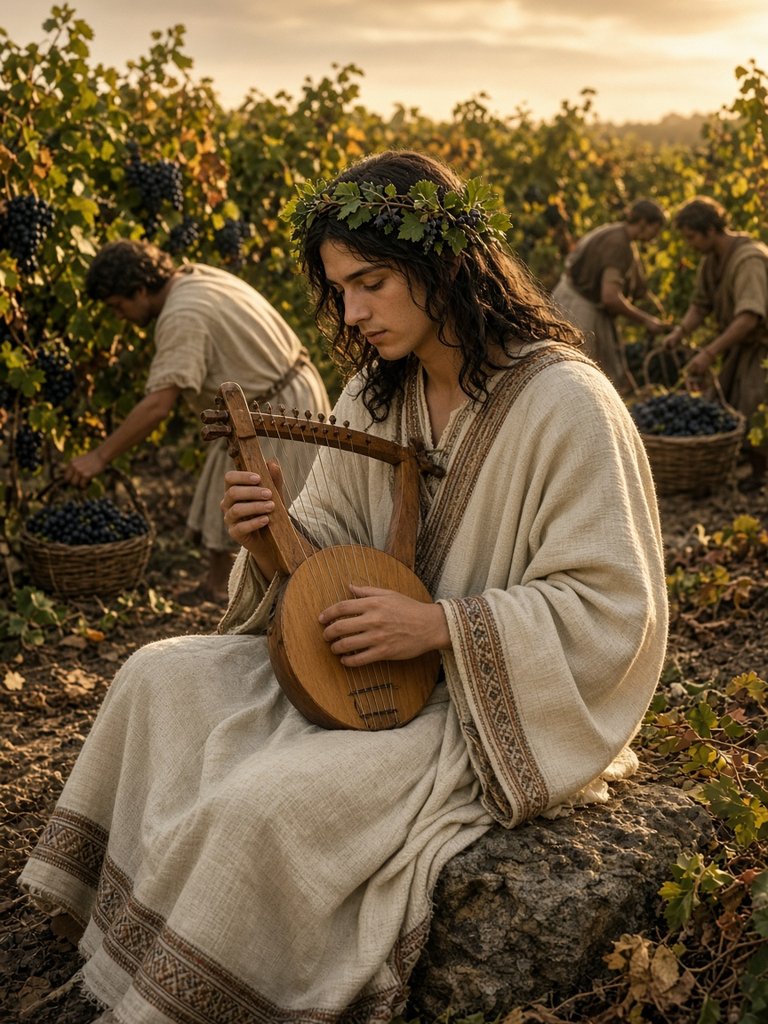
Linos was a legendary singer, mourned in the ancient lament that bore his name. On the shield of Achilles, among the grape-pickers, “there went a boy who made sweet music with his lyre, and sang the Linos-song with his clear boyish voice” (Iliad 18.569–571, tr. Butler). Herodotus heard the same song sung in Phoenicia, Cyprus and Egypt (Herodotus 2.79, paraphrased).
Accounts of him differ. Pausanias calls him a son of the Muse Ourania, killed by Apollo for claiming to be his equal in song (9.29.6, paraphrased). Apollodorus makes him a son of Oiagros and Kalliope and brother of Orpheus (1.3.2, paraphrased).
In another story Linos taught music to the young Herakles, struck him for his clumsiness, and was killed by the boy with a blow of the lyre (Apollodorus 2.4.9, paraphrased). Pausanias reports that the Thebans claimed his grave, and that on Mount Helikon he was honoured each year before the Muses (9.29.6–9, paraphrased).
Epithets
- Λίνος · Linos
- Linus
Symbols and virtues
Song, lament, and the death of the young singer. Symbols: the lyre, the vintage.
Myths
- The Linos-song. Iliad 18.569–571; Herodotus 2.79.
- Killed by Apollo. Pausanias 9.29.6.
- Brother of Orpheus. Apollodorus 1.3.2.
- Teacher of Herakles. Apollodorus 2.4.9.
Cult and places
- Mount Helikon. An image of Linos stood in a grotto, honoured each year before the Muses (Pausanias 9.29.6).
In the poets
“There went a boy who made sweet music with his lyre, and sang the Linos-song with his clear boyish voice.”Homer, Iliad 18.569–571, tr. Samuel Butler (1898), public domain.
Sources
Homer, Iliad 18.569–572; Herodotus 2.79; Apollodorus 1.3.2, 2.4.9; Pausanias 2.19.8, 9.29.6–9.
Quotations in public-domain translations (Evelyn-White 1914, Butler 1898/1900, Taylor 1792); other authors paraphrased.