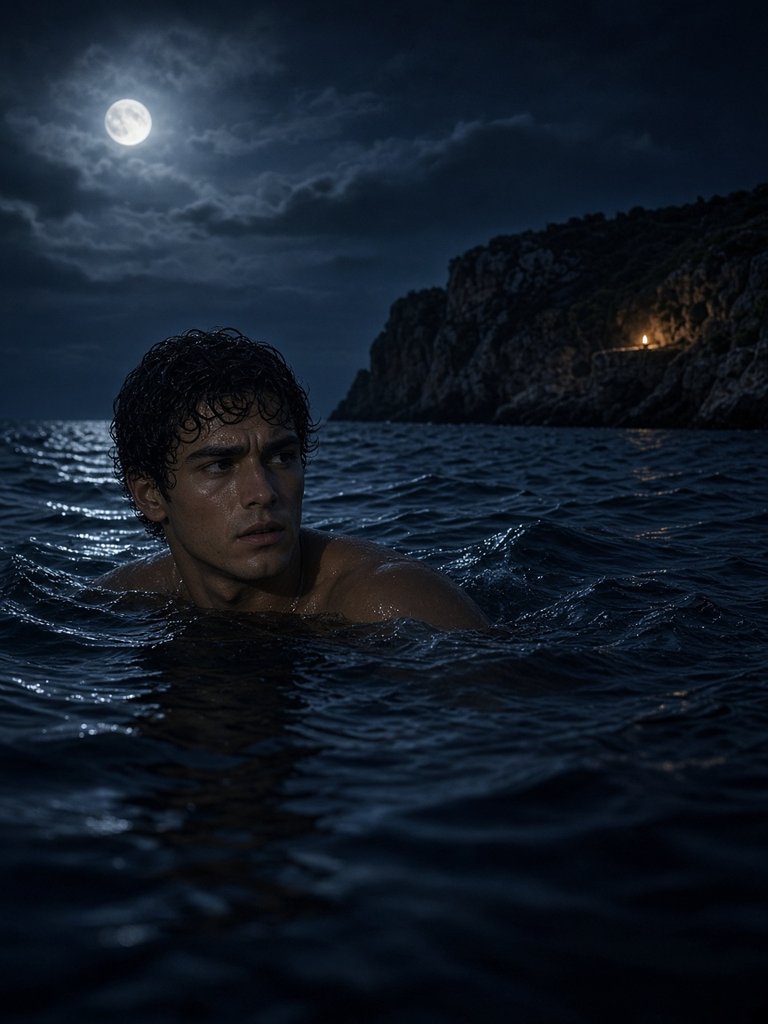
Leandros was a young man of Abydos on the Asian shore of the Hellespont. At a festival he fell in love with Hero, a priestess of Aphrodite who lived in a tower at Sestos on the opposite shore (Musaeus, Hero and Leander 1–220, paraphrased).
Because their love had to be secret, he swam across the strait every night, guided by a lamp that Hero set burning in her tower, and returned before dawn (Musaeus, Hero and Leander 221–288; Ovid, Heroides 18–19, paraphrased). Virgil alludes to the youth who swims through the stormy straits by night, driven by love (Georgics 3.258–263, paraphrased).
One winter night a storm put out the lamp, and Leandros, losing his way in the waves, drowned. At dawn Hero saw his body on the rocks below the tower and threw herself down to die beside him (Musaeus, Hero and Leander 289–343, paraphrased). Strabo mentions the tower of Hero at Sestos (13.1.22).
Epithets
- Λέανδρος · Leandros
- Leander
Symbols and virtues
Love that dares the sea, and its tragic end. Symbols: the lamp, the strait at night.
Myths
- Love for Hero. Musaeus, Hero and Leander 1–220.
- The nightly swim. Musaeus 221–288; Ovid, Heroides 18–19.
- The storm and his death. Musaeus 289–343.
- The tower at Sestos. Strabo 13.1.22.
Sources
Virgil, Georgics 3.258–263; Ovid, Heroides 18–19; Strabo 13.1.22; Musaeus, Hero and Leander.
Quotations in public-domain translations (Evelyn-White 1914, Butler 1898/1900, Taylor 1792); other authors paraphrased.