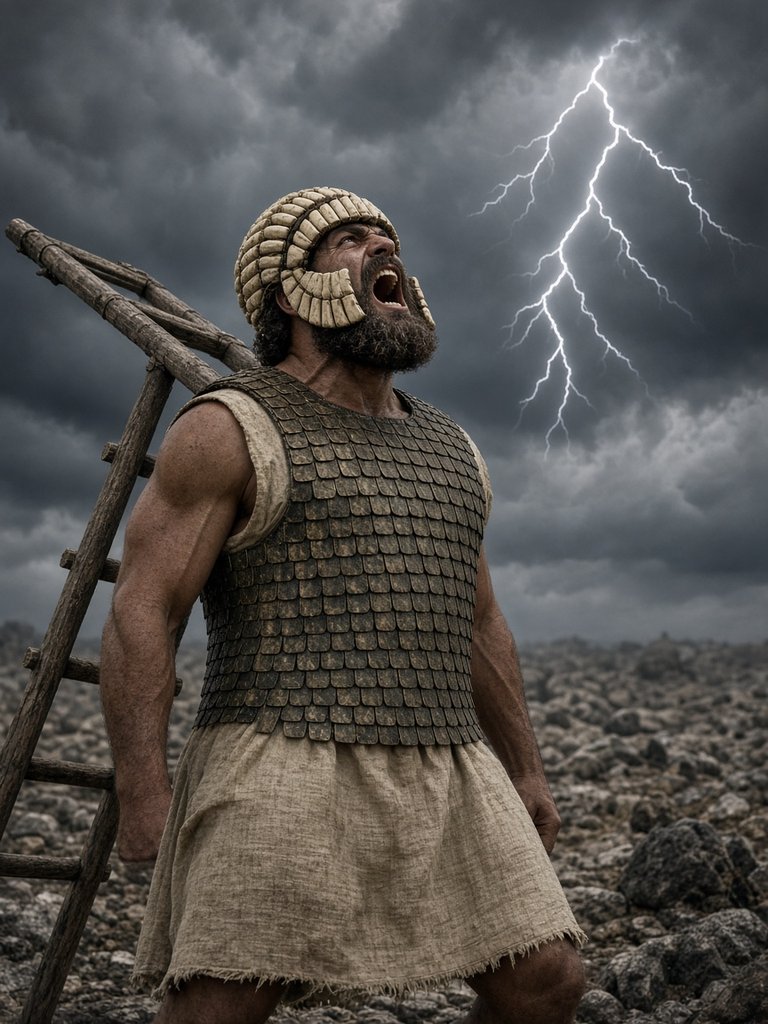
Kapaneus was one of the Seven against Thebes and the father of Sthenelos, whom the Iliad calls “Sthenelus son of famed Capaneus” (Iliad 2.564, tr. Butler). His son boasts that the sons did better than their fathers: “we took seven-gated Thebes, though the wall was stronger and our men were fewer in number, for we trusted in the omens of the gods and in the help of Jove, whereas they perished through their own sheer folly” (Iliad 4.405–409, tr. Butler).
Kapaneus was the most arrogant of the Seven. He boasted that he would sack Thebes whether the gods willed it or not, and that not even the fire of Zeus would stop him (Aeschylus, Seven against Thebes 423–446, paraphrased). As he climbed the wall on a ladder, Zeus struck him with a thunderbolt (Euripides, Phoenician Women 1172–1186; Apollodorus 3.6.7, paraphrased).
His wife Euadne threw herself onto his funeral pyre (Euripides, Suppliant Women 980–1071, paraphrased). Some said Asklepios raised him from the dead (Apollodorus 3.10.3).
Epithets
- ἀγακλειτός · agakleitos
- far-famed (Iliad 2.564)
Symbols and virtues
Pride that defies heaven. Symbols: the scaling ladder, the thunderbolt.
Myths
- The boast. Aeschylus, Seven against Thebes 423–446.
- Struck by lightning on the ladder. Euripides, Phoenician Women 1172–1186.
- Euadne on the pyre. Euripides, Suppliant Women 980–1071.
In the poets
“We took seven-gated Thebes, though the wall was stronger and our men were fewer in number.”Sthenelos son of Kapaneus, Homer, Iliad 4.406–407, tr. Samuel Butler (1898), public domain.
Sources
Homer, Iliad 2.564, 4.403–410; Aeschylus, Seven against Thebes 423–446; Euripides, Phoenician Women 1172–1186, Suppliant Women 980–1071; Apollodorus 3.6.3–7.
Quotations in public-domain translations (Evelyn-White 1914, Butler 1898/1900, Taylor 1792); other authors paraphrased.