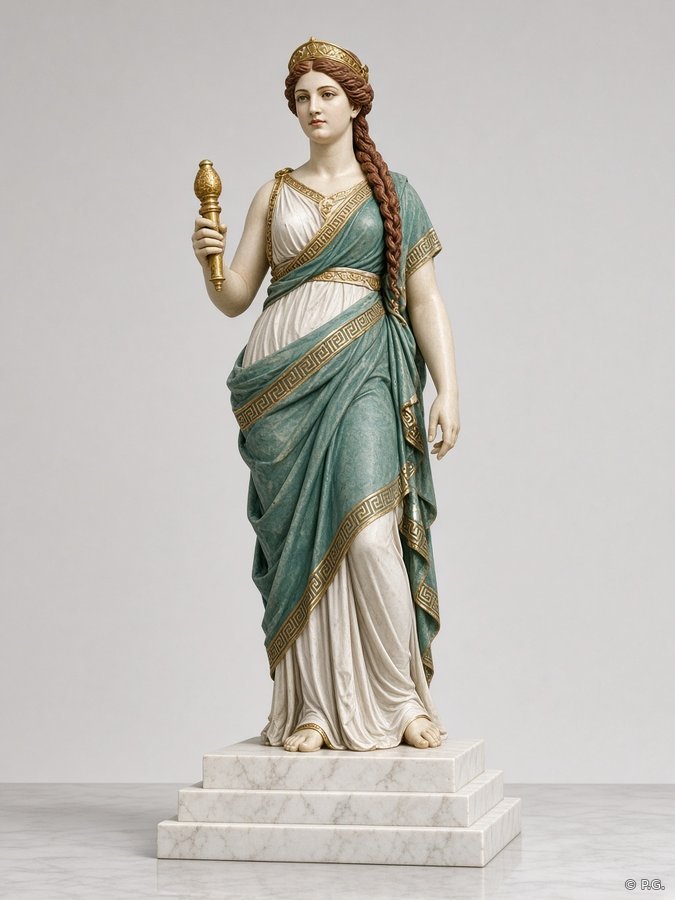
Kalypso, “she who conceals”, is a goddess of the far island of Ogygia, at the navel of the sea (Odyssey 1.50). Homer makes her the daughter of Atlas, who knows the depths of every sea and holds the pillars that keep earth and heaven apart (Odyssey 1.52–54); Hesiod names a “charming Calypso” among the daughters of Okeanos and Tethys (Theogony 359).
She lived in a great cave with a fire of cedar and citron-wood, singing at her loom with a golden shuttle, amid alder, poplar and cypress, a vine heavy with grapes and four springs of clear water; even Hermes stood and marvelled at it (Odyssey 5.55–75). She kept Odysseus seven years and offered to make him immortal and ageless (Odyssey 5.135–136; 7.255–260). When Hermes brought the command of Zeus, she complained of the gods’ jealousy but obeyed, gave him tools and cloth for a raft, and sent him off with a fair wind (Odyssey 5.116–144, 5.228–268). Hesiod says she bore him two sons, Nausithoos and Nausinoos (Theogony 1017–1018).
Epithets
- Δῖα θεάων · Dia theaon
- bright among goddesses (Odyssey 1.14)
- Πότνια νύμφη · Potnia nymphe
- lady nymph (Odyssey 1.14)
- Δολόεσσα · Doloessa
- wily (Odyssey 7.245)
Domains and symbols
Shelter and concealment (her name is linked with kalyptein, “to cover”), the far island, weaving and song, and at last the gift of passage home. Admire: hospitality, letting go with good grace. Sacred symbols: the cave, the loom and golden shuttle, the vine, the four springs.
Myths
- Daughter of Atlas. Odyssey 1.52–54; an Okeanid in Hesiod (Theogony 359).
- The cave on Ogygia. Odyssey 5.55–75.
- Seven years. Odysseus held on Ogygia (Odyssey 7.259).
- The offer of immortality. Refused for the sake of home (Odyssey 5.135–136, 5.203–224).
- The raft. She gives tools, cloth and a fair wind (Odyssey 5.228–268).
- Mother of two sons. Nausithoos and Nausinoos (Theogony 1017–1018).
Offerings
No cult of Kalypso is recorded. Today: welcome a guest, and help someone on their way.
Beneath the Divine Mind
Kalypso is the Divine Mind as the beautiful refuge that must at last be left. Her offer of ageless ease is refused for the harder road home; the soul’s return passes through such islands without staying. Like every god she stands beneath the One (The One and the Many).
Honouring Kalypso today
- Hospitality. Feed and shelter a guest.
- Letting go. Help someone leave for a better road, as she did.
- Reading. Read Odyssey 5.
Hymn
And the bright goddess Calypso was joined to Odysseus in sweet love, and bare him Nausithous and Nausinous.Hesiod, Theogony 1017–1018, tr. H. G. Evelyn-White (1914), public domain. There is no Homeric or Orphic hymn to Kalypso.
Sources
Homer, Odyssey 1.13–15, 1.50–54, 5.55–268, 7.244–266; Hesiod, Theogony 359, 1017–1018.
Quotations in public-domain translations (Evelyn-White 1914, Butler 1898/1900, Taylor 1792); other authors paraphrased.