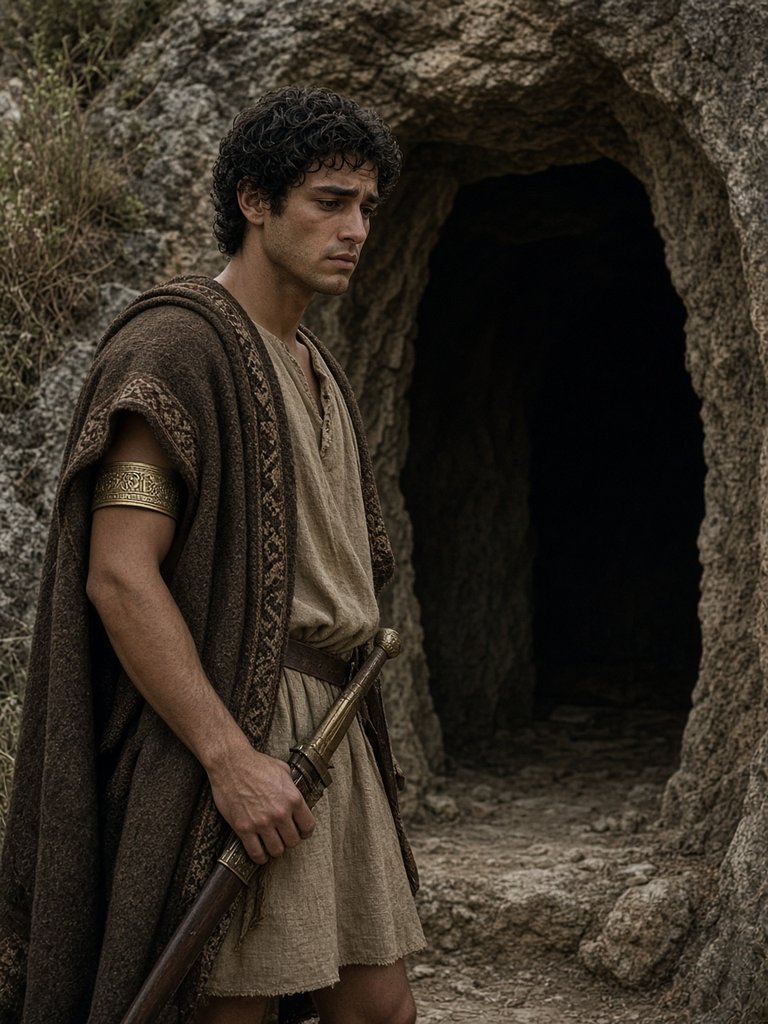
Haimon was the son of Kreon, king of Thebes. In one older tradition he was among the Thebans killed by the Sphinx before Oidipous solved its riddle (Apollodorus 3.5.8, paraphrased). In Sophocles he is betrothed to Antigone.
In Sophocles’ Antigone, when Kreon condemns Antigone for burying her brother, Haimon comes to his father, first respectfully and then in anger, telling him that the city secretly sides with her and that a ruler who will not listen is no ruler at all (Antigone 631–765, paraphrased). Kreon will not yield, and Haimon leaves vowing that his father will never see him again.
When Kreon, warned by Teiresias, finally went to free Antigone, he found Haimon in the rock tomb clinging to her body, for she had hanged herself. Haimon lunged at his father with his sword, missed, and then drove it into himself; on hearing the news Kreon’s wife killed herself as well (Antigone 1192–1243, 1278–1316, paraphrased).
Epithets
- Κρεόντειος · Kreonteios
- son of Kreon
Symbols and virtues
Love and loyalty set against a father’s pride. Symbols: the sword, the rock tomb.
Myths
- Killed by the Sphinx. Apollodorus 3.5.8.
- The argument with Kreon. Sophocles, Antigone 631–765.
- Death in the tomb of Antigone. Sophocles, Antigone 1192–1243.
Sources
Sophocles, Antigone; Euripides, Phoenician Women 757–760, 944–946; Apollodorus 3.5.8; Pausanias 9.5.13.
Quotations in public-domain translations (Evelyn-White 1914, Butler 1898/1900, Taylor 1792); other authors paraphrased.