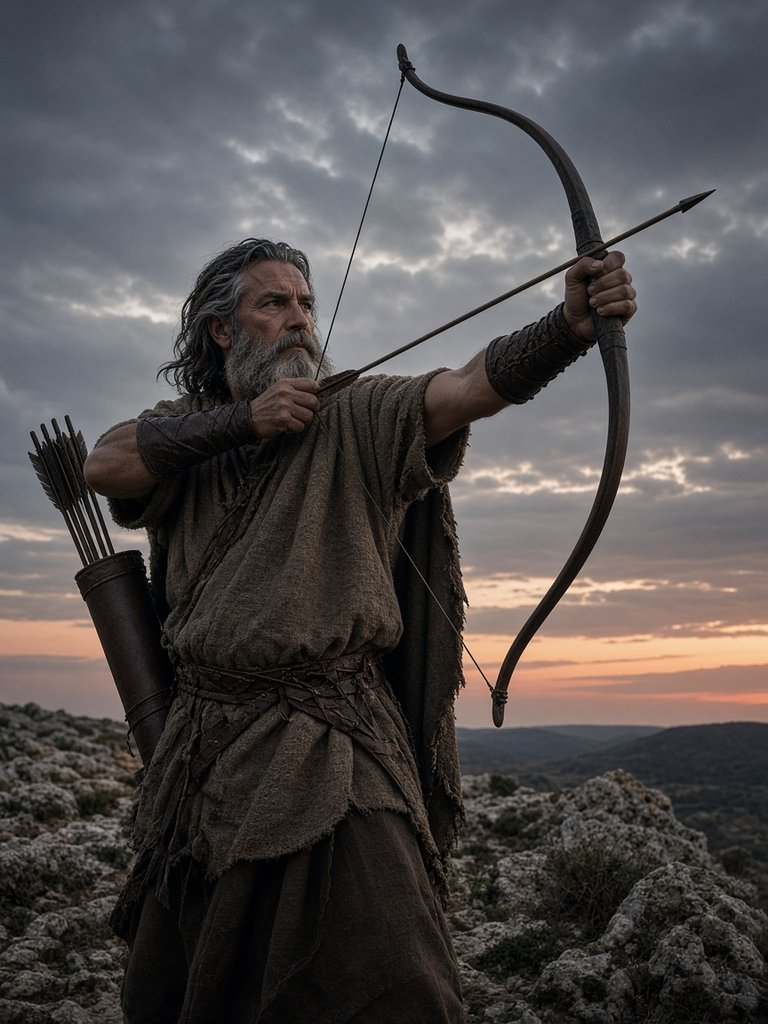
Eurytos, king of Oichalia, was the greatest archer of the age before Troy. Odysseus, boasting of his own skill among the Phaeacians, says he would not shoot against the mighty dead, “such as Hercules, or Eurytus the Oechalian—men who could shoot against the gods themselves. This in fact was how Eurytus came prematurely by his end, for Apollo was angry with him and killed him because he challenged him as an archer” (Odyssey 8.224–228, tr. Butler).
His great bow passed to his son Iphitos, who gave it to the young Odysseus; it is the bow with which Odysseus later kills the suitors (Odyssey 21.11–41, paraphrased).
In another tradition he offered his daughter Iole to whoever could beat him and his sons at archery. Herakles won but was refused, and later sacked Oichalia, killed Eurytos and carried off Iole, which led to Herakles’ own death (Sophocles, Women of Trachis; Apollodorus 2.6.1, 2.7.7, paraphrased).
Epithets
- Οἰχαλιεύς · Oichalieus
- the Oichalian (Odyssey 8.224)
- τοξότης · toxotēs
- the archer
Symbols and virtues
Pride in skill that challenges the gods. Symbols: the great bow.
Myths
- Challenging Apollo. Odyssey 8.223–228.
- The bow passed on. Odyssey 21.11–41.
- Iole and Herakles. Sophocles, Women of Trachis; Apollodorus 2.6.1.
In the poets
“This in fact was how Eurytus came prematurely by his end, for Apollo was angry with him and killed him because he challenged him as an archer.”Homer, Odyssey 8.226–228, tr. Samuel Butler (1900), public domain.
Sources
Homer, Iliad 2.596, 2.730; Odyssey 8.223–228, 21.11–41; Sophocles, Women of Trachis; Apollodorus 2.6.1–2, 2.7.7.
Quotations in public-domain translations (Evelyn-White 1914, Butler 1898/1900, Taylor 1792); other authors paraphrased.