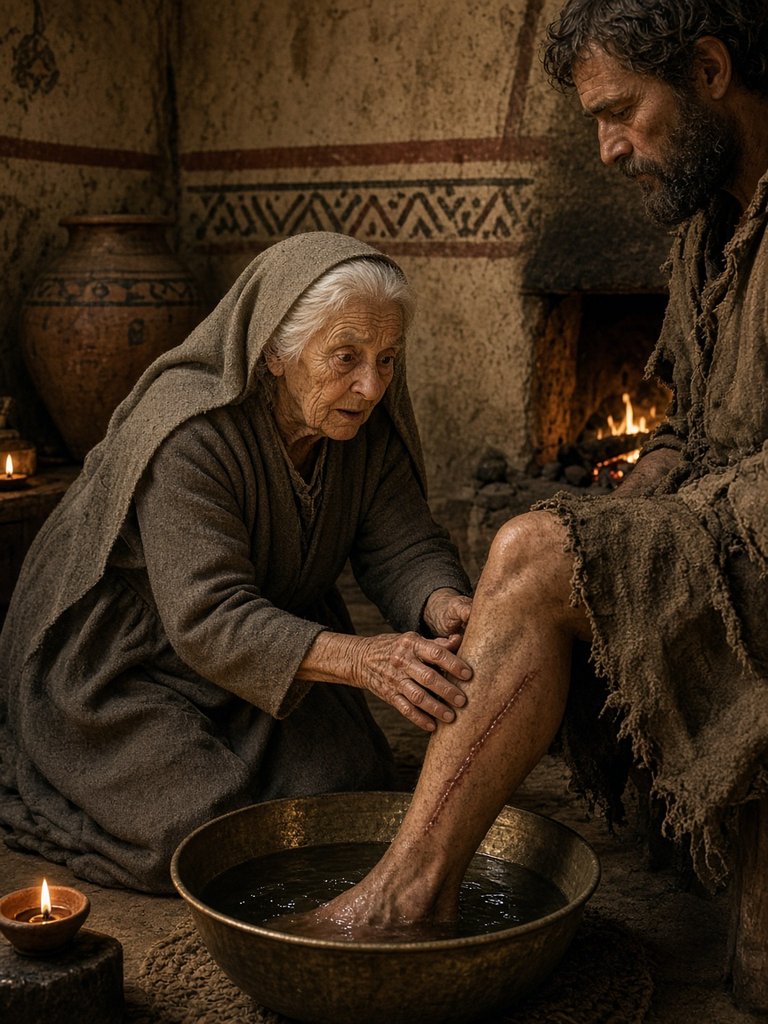
Eurykleia, daughter of Ops, was the nurse of Odysseus and then of Telemachos. “Laertes had bought her with his own money when she was quite young; he gave the worth of twenty oxen for her, and shewed as much respect to her in his household as he did to his own wedded wife” (Odyssey 1.430–432, tr. Butler). She keeps the storeroom and helps Telemachos set out secretly for Pylos (Odyssey 2.345–380, paraphrased).
When Odysseus comes home disguised as a beggar, Penelope asks her to wash his feet. Feeling the scar left by a boar’s tusk when he hunted on Parnassos as a youth, she knows him at once and drops his foot into the basin; he grips her throat and makes her keep silent (Odyssey 19.386–502, paraphrased).
After the killing of the suitors she identifies the disloyal maidservants and runs to wake Penelope with the news (Odyssey 22.390–501, 23.1–84, paraphrased).
Epithets
- Ὦπος θυγάτηρ · Ōpos thugatēr
- daughter of Ops
- τροφός · trophos
- the nurse
Symbols and virtues
Faithful service and love that recognises the truth. Symbols: the basin of water, the scar, the torch.
Myths
- Bought by Laertes. Odyssey 1.428–435.
- Telemachos’ journey. Odyssey 2.345–380.
- The scar. Odyssey 19.386–502.
- Waking Penelope. Odyssey 23.1–84.
In the poets
“Laertes had bought her with his own money when she was quite young; he gave the worth of twenty oxen for her, and shewed as much respect to her in his household as he did to his own wedded wife.”Homer, Odyssey 1.430–432, tr. Samuel Butler (1900), public domain.
Sources
Homer, Odyssey 1.428–442, 2.345–380, 19.357–507, 22.390–501, 23.1–84.
Quotations in public-domain translations (Evelyn-White 1914, Butler 1898/1900, Taylor 1792); other authors paraphrased.