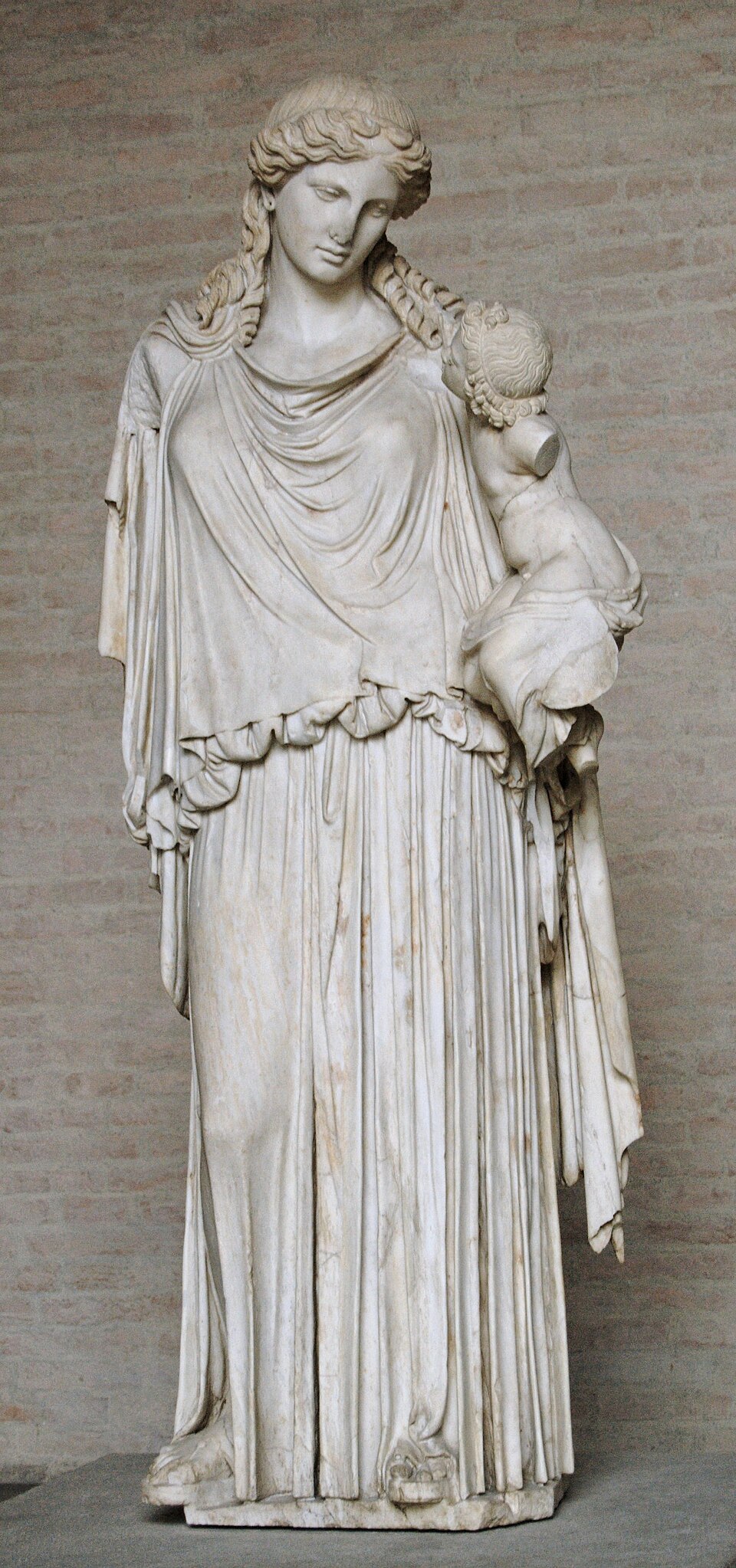
Bibi Saint-Pol, Public domain, via Wikimedia Commons

Eirene, “Peace”, is a daughter of Zeus and Themis and one of the three Horai with Eunomia and Dike: “Next he married bright Themis who bare the Horae (Hours), and Eunomia (Order), Dike (Justice), and blooming Eirene (Peace), who mind the works of mortal men” (Theogony 901–903). Pindar calls the three sisters the sure foundation of cities, givers of wealth to men (Olympian 13.6–8, paraphrased).
Athens gave her a public cult. After the naval victory of 375 BC, Isocrates says, the city first sacrificed to Peace and kept the sacrifice every year (Antidosis 109–110, paraphrased), and Nepos records altars to Peace set up then (Timotheus 2.2, paraphrased). Kephisodotos made the bronze statue of Eirene holding the child Ploutos that stood in the Agora (Pausanias 1.8.2; 9.16.2, paraphrased), the type copied in the marble shown here: Peace nursing Wealth. In Aristophanes’ Peace (421 BC) the farmer Trygaios flies to heaven on a dung-beetle and hauls the goddess out of the pit where War had buried her. Rome honoured her as Pax, with the Ara Pacis of Augustus and Vespasian’s Temple of Peace.
Epithets
- Τεθαλυῖα · Tethalyia
- blooming (Theogony 902)
- Βαθύπλουτος · Bathyploutos
- deep in wealth (Euripides, Kresphontes, fragment 453)
Domains and symbols
Peace, prosperity, the harvest that follows the end of war. Admire: reconciliation, patience, the work of peace. Sacred symbols: the child Ploutos, the cornucopia, the olive branch, the sceptre.
Myths
- Daughter of Zeus and Themis. One of the Horai (Theogony 901–903).
- Peace nursing Wealth. The statue by Kephisodotos (Pausanias 1.8.2; 9.16.2).
- Freed from the pit. Aristophanes, Peace.
- Pax at Rome. The Ara Pacis Augustae and the Temple of Peace.
Cult sites
- Athens, the Agora. Statue of Eirene with Ploutos by Kephisodotos (Pausanias 1.8.2).
- Athens. A yearly state sacrifice to Peace from 375 BC (Isocrates, Antidosis 109–110; Nepos, Timotheus 2.2).
- Rome. Ara Pacis Augustae (13–9 BC) and Templum Pacis (AD 75).
Festivals
- Yearly sacrifice to Eirene, Athens. Instituted after 375 BC (Isocrates, Antidosis 109–110).
Offerings
The Athenian sacrifice to Peace was a state offering. In Aristophanes’ Peace, Trygaios will not stain her altar with blood, since Peace takes no pleasure in slaughter (1017–1022, paraphrased). Today: an olive branch, grain or fruit, and an act of reconciliation.
Beneath the Divine Mind
Eirene is the Divine Mind as rest in right order: when justice and good order stand, peace blooms and wealth grows. Like every god she stands beneath the One (The One and the Many).
Honouring Eirene today
- Reconcile. End one quarrel.
- Build. Support the work of peace in your city.
- Olive. Set an olive branch on your shrine.
Hymn
“Next he married bright Themis who bare the Horae (Hours), and Eunomia (Order), Dike (Justice), and blooming Eirene (Peace), who mind the works of mortal men.”Hesiod, Theogony 901–903, tr. H. G. Evelyn-White (1914), public domain. Orphic Hymn 43 is to the Horai together; there is no Homeric hymn to Eirene.
Sources
Hesiod, Theogony 901–903; Pindar, Olympian 13.6–8; Aristophanes, Peace; Isocrates, Antidosis 109–110; Nepos, Timotheus 2.2; Pausanias 1.8.2, 9.16.2; Orphic Hymn 43.
Quotations in public-domain translations (Evelyn-White 1914, Butler 1898/1900, Taylor 1792); other authors paraphrased.