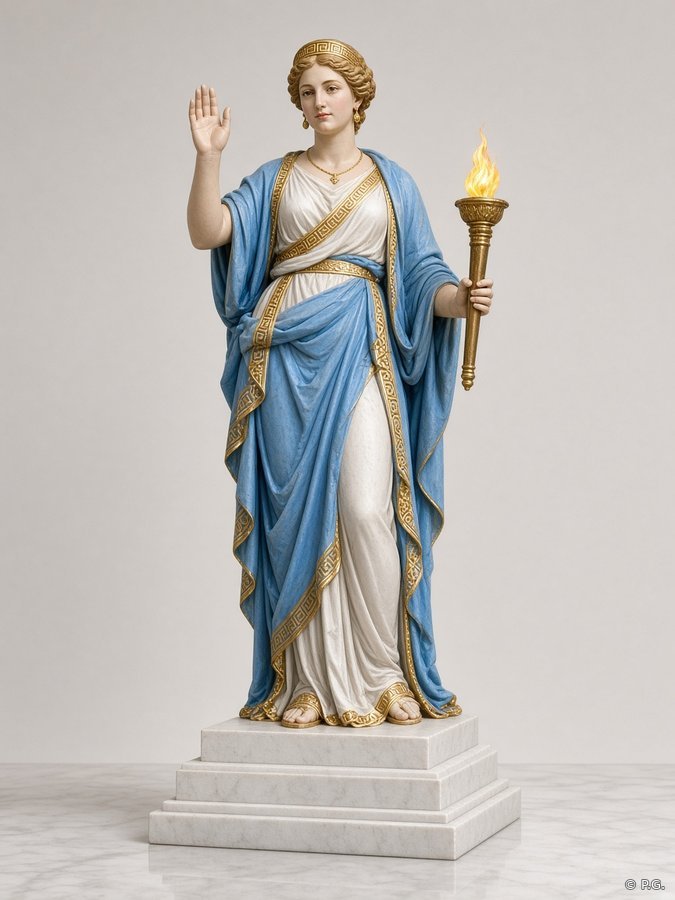
Eileithyia, goddess of childbirth, is the daughter of Zeus and Hera (Theogony 921–923). Hera kept her on Olympus so that Leto could not give birth, until Iris brought her to Delos with a necklace nine cubits long (Homeric Hymn to Apollo 97–116). Hera also held back the Eileithyiai to delay the birth of Herakles (Iliad 19.114–119). Her cave was at Amnisos in Crete (Odyssey 19.188).
Epithets
- Μογοστόκος · Mogostokos
- of the pangs of birth (Iliad 11.270)
Domains and symbols
Labour and birth; the safe arrival of the child. Admire: care for mothers. Sacred symbol: the torch.
Myths
- The birth on Delos. Until Eileithyia came, Leto lay nine days in labour (Homeric Hymn to Apollo 91–119).
- Herakles. Hera stopped her at Alkmene’s door (Iliad 19.114–119).
Cult sites
- Amnisos, Crete. Her cave (Odyssey 19.188).
- Athens. A temple with three wooden images, two brought from Crete (Pausanias 1.18.5).
- Olympia. A sanctuary of Eileithyia and the child-god Sosipolis (Pausanias 6.20.2–3).
Offerings
Honey cakes, incense, a lit torch. Today: pray to her with Hera before a birth.
Beneath the Divine Mind
Eileithyia is the Divine Mind as coming-to-be: the passage of a life into the light, personified and deified as the goddess of birth. Like every god she stands beneath the One (The One and the Many).
Honouring Eileithyia today
- Before a birth. Light a torch or candle and pray for mother and child.
- Hymn. Recite the Orphic hymn below.
Hymn
O venerable goddess, hear my pray’r, for labour pains are thy peculiar care; in thee, when stretch’d upon the bed of grief, the sex as in a mirror view relief.Orphic Hymn 2, To Prothyraia (Eileithyia), 1–4. Tr. Thomas Taylor (1792), public domain.
Sources
Hesiod, Theogony 921–923; Homeric Hymn to Apollo 89–119; Homer, Iliad 11.270, 19.114–119, Odyssey 19.188; Orphic Hymn 2; Pausanias 1.18.5 and 6.20.2–3.
Quotations in public-domain translations (Evelyn-White 1914, Butler 1898/1900, Taylor 1792); other authors paraphrased.