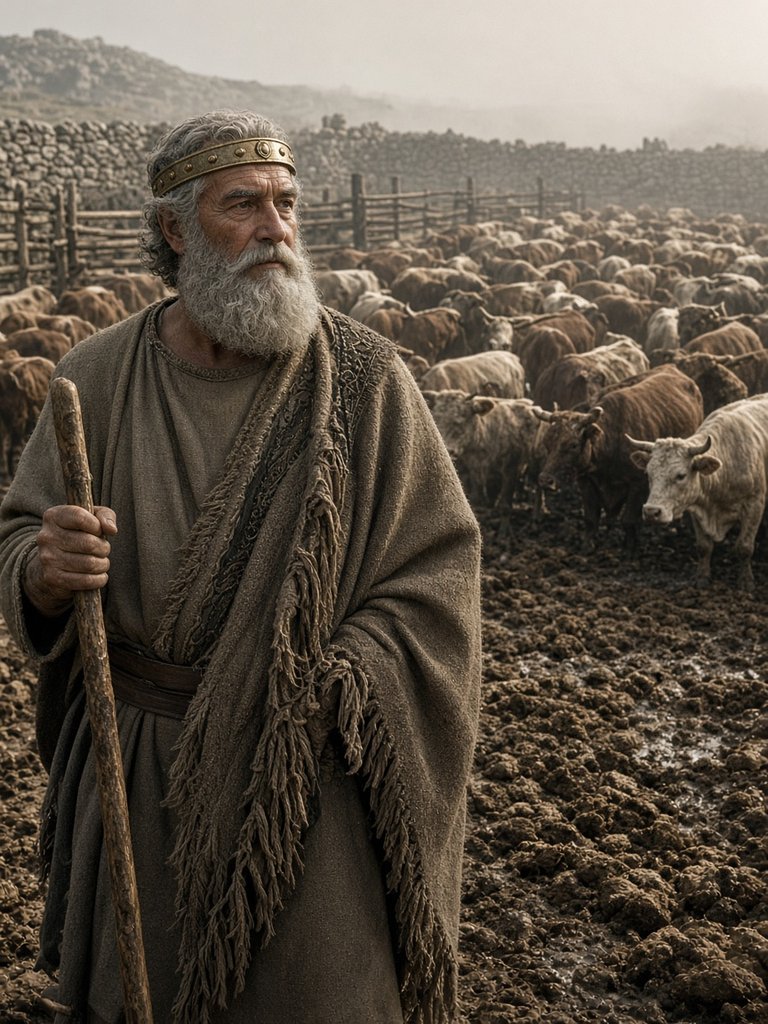
Augeas was king of the Epeans in Elis, called a son of Helios, and owned more cattle than anyone. As his fifth labour Herakles was ordered to clear the dung from his cattle yards in a single day; he did so by breaking through the walls and turning the rivers Alpheios and Peneios through them (Apollodorus 2.5.5, paraphrased).
Augeas refused the promised reward of a tenth of the herd, and banished his own son Phyleus for bearing witness against him (Apollodorus 2.5.5, paraphrased). Herakles later returned with an army, killed the Molione who fought for Augeas, then killed Augeas and his sons and made Phyleus king; Pindar says that afterward he founded the Olympic games (Apollodorus 2.7.2; Pindar, Olympian 10.24–59, paraphrased).
Nestor recalls Augeas as an old enemy of Pylos. The Pylians had sent four prize horses to the games in Elis: “They and their chariots with them had gone to the games and were to run for a tripod, but King Augeas took them, and sent back their driver grieving for the loss of his horses” (Iliad 11.699–702, tr. Butler). His grandson Polyxenos led the Epeans at Troy (Iliad 2.623–624).
Epithets
- Ἡλιάδης · Hēliadēs
- son of Helios
Symbols and virtues
Wealth, ingratitude and a broken bargain. Symbols: the vast herds, the diverted rivers.
Myths
- The cattle yards cleaned. Apollodorus 2.5.5.
- The withheld reward. Apollodorus 2.5.5.
- Killed by Herakles; the Olympic games. Apollodorus 2.7.2; Pindar, Olympian 10.24–59.
- The horses of Neleus. Iliad 11.698–702.
In the poets
“They and their chariots with them had gone to the games and were to run for a tripod, but King Augeas took them, and sent back their driver grieving for the loss of his horses.”Homer, Iliad 11.699–702, tr. Samuel Butler (1898), public domain.
Sources
Homer, Iliad 2.615–624, 11.698–702; Pindar, Olympian 10.24–59; Apollodorus 2.5.5, 2.7.2; Pausanias 5.1.9–10, 5.2.1–5, 5.3.1.
Quotations in public-domain translations (Evelyn-White 1914, Butler 1898/1900, Taylor 1792); other authors paraphrased.