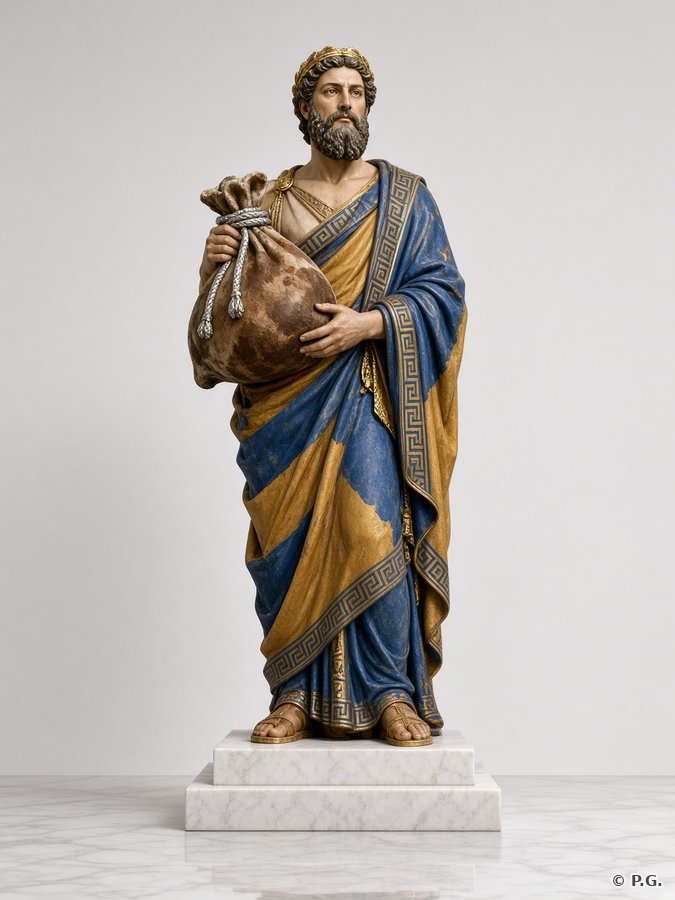
Aiolos rules the floating island of Aiolia, girt with an unbroken wall of bronze and sheer rock. Odysseus tells the Phaiakians: “Thence we went on to the Aeolian island where lives Aeolus son of Hippotas, dear to the immortal gods” (Odyssey 10.1–2, tr. Butler). He lives there with his wife and his six sons and six daughters, feasting day after day (10.5–12). He entertains Odysseus for a month, and when Odysseus asks to go, he gives him the winds in a bag: “he flayed me a prime ox-hide to hold the ways of the roaring winds, which he shut up in the hide as in a sack—for Jove had made him captain over the winds, and he could stir or still each one of them according to his own pleasure” (10.19–22, tr. Butler).
Only the West Wind is left free to blow the ship home. Within sight of Ithaka, while Odysseus sleeps, his men open the bag thinking it full of gold, and the winds blow them back to Aiolia. This time Aiolos drives Odysseus away as one hated by the gods (10.28–76). In Apollonius Hera sends Iris to Aiolos to still the winds for the Argo (Argonautica 4.764–769); in Virgil Juno bribes him to loose the winds from their cave against the Trojan fleet (Aeneid 1.50–123). Diodorus places him in the Lipari islands and remembers him as a just and pious ruler who foretold the winds (Diodorus 5.7).
Epithets
- Ἱπποτάδης · Hippotades
- son of Hippotas (Odyssey 10.2, 10.36)
- Ταμίης ἀνέμων · Tamies anemon
- steward of the winds (Odyssey 10.21)
- Φίλος ἀθανάτοισι θεοῖσι · Philos athanatoisi theoisi
- dear to the immortal gods (Odyssey 10.2)
Domains and symbols
The winds held and released: favourable passage, the right wind at the right time. Admire: hospitality, the trust that keeps a gift unopened. Sacred symbols: the ox-hide bag bound with a silver cord, the floating island with its wall.
Myths
- The floating island. Aiolia with its wall and cliffs (Odyssey 10.1–4).
- The bag of winds. Given to Odysseus, opened by his men (10.19–55).
- Odysseus turned away. On his return Aiolos sends him off as hated by the gods (10.56–76).
- The Argo. Hera, through Iris, asks him to still the winds (Apollonius 4.764–769).
- Juno’s storm. He looses the winds against Aeneas (Virgil, Aeneid 1.50–123).
Offerings
No cult of Aiolos is recorded in Homer. Sailors prayed to the winds themselves (see the Orphic hymns to Boreas, Zephyros and Notos). Today: a prayer for a fair wind before a journey.
Beneath the Divine Mind
Aiolos is the Divine Mind as governance of motion: each wind stirred or stilled in measure. He gives Odysseus all he needs, and only folly undoes it. Like every god he stands beneath the One (The One and the Many).
Honouring Aiolos today
- Journey. Before travelling, ask for a fair wind.
- Trust. Keep what is entrusted to you unopened.
- Hospitality. Feast a guest well and listen to his story, as Aiolos did for a month.
Sources
Homer, Odyssey 10.1–76, 23.314–316; Apollonius, Argonautica 4.764–769; Virgil, Aeneid 1.50–123; Diodorus Siculus 5.7. Quotations from Homer are in the prose translation of Samuel Butler (Odyssey 1900), public domain, which gives the gods their Latin names (Jove, Neptune).
Quotations in public-domain translations (Evelyn-White 1914, Butler 1898/1900, Taylor 1792); other authors paraphrased.